Loading…
Guide
Niacinamide and Vitamin C: Can You Use Them Together?
12 min read
At some point the internet decided niacinamide and vitamin C must never touch. People bought two serums, then read that using them together would turn one into the other, or make their face flush, or cancel both out. We still get emails from customers who have been carefully applying one at 7am and the other at 10pm for years. You can use niacinamide and vitamin C together. Here is where the warning came from, why it does not hold up, and how we would actually layer them.
Can you use niacinamide and vitamin C together?
Yes. The "never mix" rule traces back to laboratory chemistry from the 1960s, which looked at the two ingredients dissolved together in solution, not at skin. Modern products combine them in the same bottle, and a 2025 trial of a serum containing both, used twice a day for five months, found it better tolerated than the prescription cream it was compared with (Rocio and colleagues, 2025). If your vitamin C is a strong, acidic L-ascorbic acid serum and your skin is touchy, putting one in the morning and one at night is a comfort choice, not a chemistry rule.
That is the short answer. The rest of this page is the detail: what each ingredient does, the myth and the evidence against it, the order, and where our Glow Duo (£51 for both serums) fits.
What each one does on your face
Niacinamide is a form of vitamin B3. The best-known trial put 5% niacinamide on one half of 50 women's faces and a plain base on the other, twice a day for 12 weeks, and found significant reductions in fine lines, dark spots, red blotchiness and sallowness on the niacinamide side (Bissett, Oblong and Berge, 2005). A separate study showed it reduces the handover of pigment from pigment cells to skin cells, which is why it helps the look of uneven tone (Hakozaki and colleagues, 2002). It is water-soluble, stable and generally well tolerated. We grade each of its claimed benefits in niacinamide serum benefits. If you want the full picture on strengths, our page on niacinamide at 5%, 10% or 20% goes through every trial.
Vitamin C is an antioxidant. A review in the Journal of Clinical and Aesthetic Dermatology describes it as one of the most powerful antioxidants in the skin, with roles in protecting against sun-related damage, supporting collagen and reducing melanin formation, while noting that clinical studies of topical vitamin C remain limited and the hard part is making a formula that is stable and gets into the skin (Al-Niaimi and Chiang, 2017).
So you have one ingredient that mainly works on tone, barrier and oil, and another that mainly works as an antioxidant with a side interest in tone. They overlap on brightness. That overlap is the reason people want both, and why brands keep putting them in duos.
Where the "don't mix them" myth came from
There are two strands to it, and both started somewhere real.
The yellow complex. In 1963, Guttman and Brooke published a study in the Journal of Pharmaceutical Sciences on how nicotinamide (niacinamide) and ascorbic acid (pure vitamin C) interact when they are dissolved together in solution. The two can form a loose complex, and the old worry was that this would inactivate both and turn a clear product yellow. That was a question about storing the two together in a watery solution in a jar, decades before modern cosmetic formulation. It was never a study of what happens when you put one serum on your face and then another.
The niacin flush. The second strand is that the acid in a vitamin C serum might convert niacinamide into niacin (nicotinic acid). Niacin is a different form of vitamin B3, and it is known for making skin flush. A nicotinic acid ester is used in skin research precisely because it reliably turns skin red, through the prostaglandin pathway and local nerves (Elawa and colleagues, 2020). In the body the two forms can be converted into each other (Gehring, 2004), so the idea is not absurd on its face.
What we could not find is any study showing that layering a vitamin C serum and a niacinamide serum on skin, at room temperature, for the minute or two before they absorb, produces enough niacin to flush anyone. We looked. If you have seen a figure quoted for how much niacinamide converts, ask where it came from, because we could not trace one to a skin study, so we are not giving you a number.
The safety review of niacinamide and niacin for cosmetics looked at both ingredients together and found niacinamide caused no stinging in clinical testing at up to 10% and no irritation in use tests at up to 5% (Cosmetic Ingredient Review, 2005). That is the tolerance picture for niacinamide itself.
Why the myth keeps circulating
Part of it is simply that some brands still say it. The Ordinary's own UK page for its Niacinamide 10% + Zinc 1% serum, when we checked it on 30 September 2026, lists "Direct Vitamin C" and "Indirect Vitamin C" under "Do not use with". That is a brand's guidance for its own products, and if you own that serum it is sensible to follow it: use your vitamin C at a different time of day. It does not follow that every niacinamide and every vitamin C product in the country conflict.
The other part is that people do go red. If you layer a high-strength niacinamide under a strong L-ascorbic acid serum at a very low pH, then add a fragranced moisturiser, something may well sting. The combination gets the blame. Usually one product on its own is the cause.
What the evidence on using both says
The strongest recent evidence is a randomised, investigator-blind study of 60 women with melasma. One group used a serum containing 5% niacinamide, 1% tranexamic acid, 0.2% of a stabilised form of vitamin C and several hydroxy acids for five months. Pigmentation fell significantly, and the serum was better tolerated than 4% hydroquinone, the prescription comparison (Rocio and colleagues, 2025). The study was funded by the company that makes the serum, which is normal in this field and worth knowing. Melasma is a medical condition and this is not a reason to self-treat it. The point for this page is narrower: niacinamide and a vitamin C derivative sat in the same bottle, were applied to faces twice a day for months, and nobody reported a flushing problem that stopped the trial.
That is a formula designed to hold both. Layering two separate serums is a different set-up, but if the two ingredients can live together in one bottle for months, they can sit next to each other on your cheek for a few minutes.
Which vitamin C you have makes a difference
This is the bit most guides skip, and it matters more than the order.
L-ascorbic acid is pure vitamin C. To get into the skin it has to be formulated at a pH below 3.5, and absorption peaked at 20% in the pig-skin studies that defined how these serums are made (Pinnell and colleagues, 2001). That low pH is what makes some vitamin C serums sting, and it is the one case where splitting your serums morning and night can make sense for comfort.
Derivatives are more stable forms that are gentler and less acidic. The same Pinnell study found that three derivatives it tested (magnesium ascorbyl phosphate, ascorbyl palmitate and dehydroascorbic acid) did not raise skin levels of vitamin C. Ascorbyl glucoside, the form in our serum, was not one of the three tested. It is converted to vitamin C by an enzyme, and lab work on skin cells found it has antioxidant activity of its own, even before conversion (Hanada and colleagues, 2014). That is cell research, not a trial on faces.
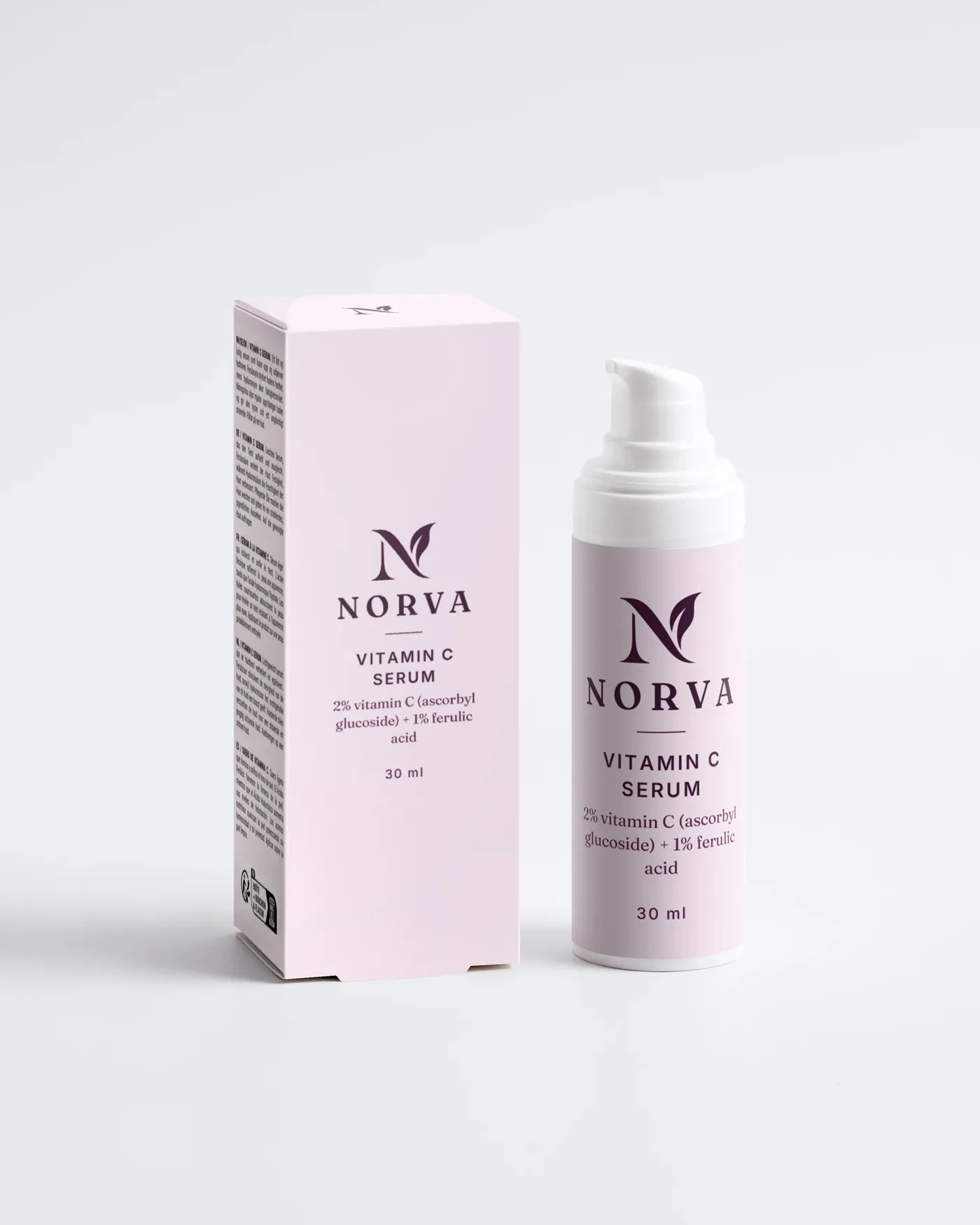
We say this plainly because it applies to our product. Our Vitamin C Serum contains 2% vitamin C as ascorbyl glucoside, with 1% ferulic acid and 1% sea buckthorn oil. It is a mild derivative at a modest strength. It is not a high-strength L-ascorbic acid serum and it will not behave like one, for better (comfort, stability) and for worse (it is a gentler antioxidant step, not the strongest on the market). If you want the most potent vitamin C you can buy, ours is not it.
The upside for this page is that a mild derivative is about as easy to layer with niacinamide as a vitamin C gets.
What order should you apply niacinamide and vitamin C?
Thinnest to thickest. That rule covers most of it.
- Cleanse, and pat skin dry.
- Vitamin C first if it is the thinner, more watery serum. Give it a minute.
- Niacinamide second.
- Moisturiser.
- Sunscreen in the morning, always last.
If both serums are creamy, like ours, the order barely matters. Put on the one you want closest to the skin first. For us that is usually vitamin C in the morning, because an antioxidant step under sunscreen is where it earns its keep. Our general guide on how to apply serums and in what order covers layering more than two products.
Sunscreen is the step that does the heavy lifting. In a randomised trial of 903 adults, the group told to use broad-spectrum sunscreen daily showed no detectable increase in skin ageing over four and a half years, and ageing was 24% less than in the group using it when they felt like it (Hughes and colleagues, 2013). Any brightening from niacinamide or vitamin C will not hold without it.
Morning, evening or both: three ways to split them
Both in the morning. Vitamin C, niacinamide, moisturiser, SPF. Simple, and the antioxidant sits under your sunscreen during the hours you are outside. Good if you want a short evening routine.
Vitamin C morning, niacinamide evening. The most common split, and the one to pick if your skin is reactive, if you own a very acidic vitamin C, or if you use The Ordinary's niacinamide serum and want to follow its guidance. It also fits people who use a retinoid or peptide at night and like one active per routine.
Niacinamide twice a day, vitamin C in the morning. The 12-week niacinamide trial applied it twice daily (Bissett, Oblong and Berge, 2005). If tone is your main concern, this gives niacinamide the same schedule the study used.
Whichever you pick, stick with it. Consistency does more than clever timing.
What we sell, and what is in each bottle
We sell both halves of this combination, and they come together as The Glow Duo: £51 for the pair, £9 less than buying them separately.
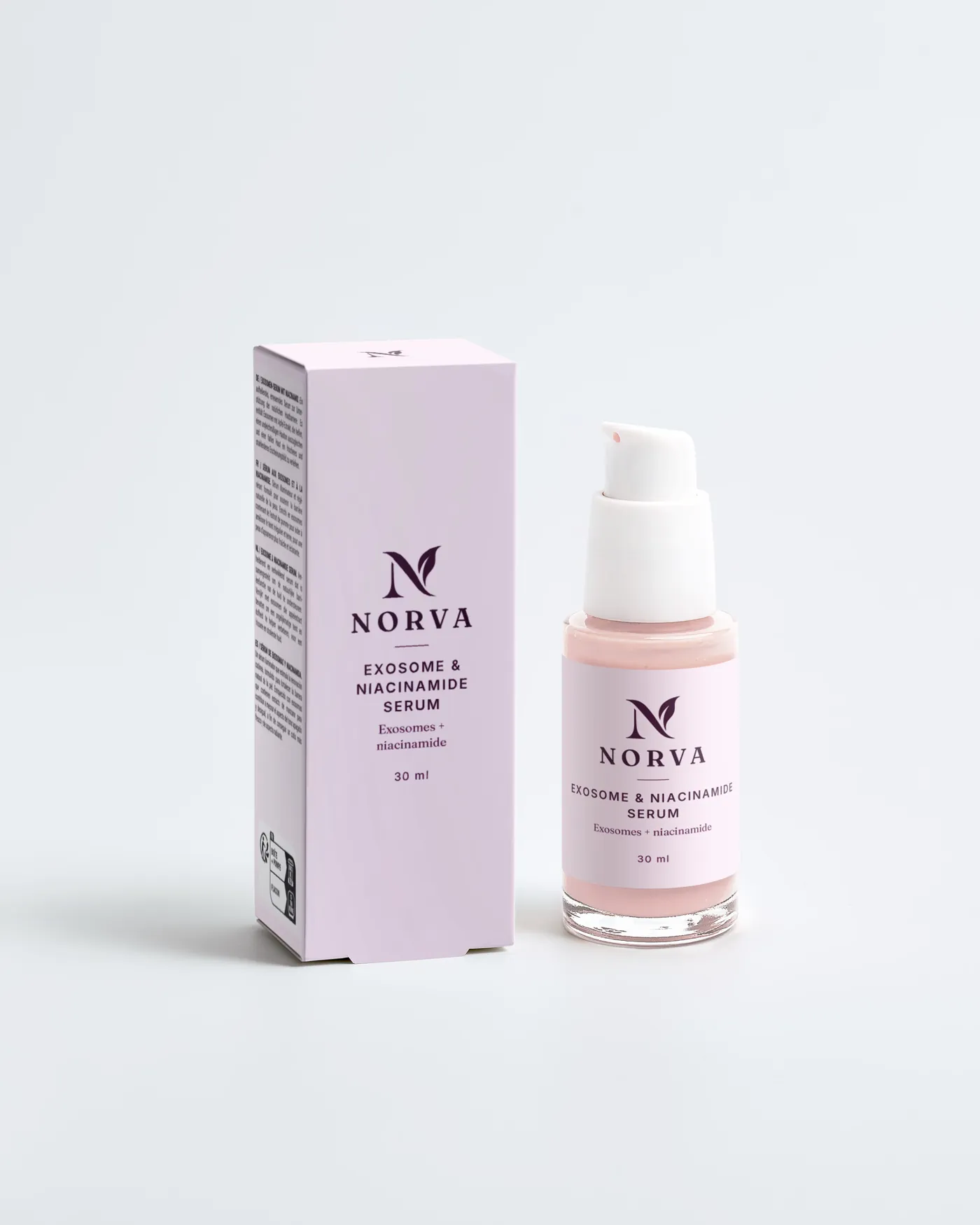
Exosome & Niacinamide Serum, £30 for 30 ml. Niacinamide with apple-derived exosomes, a lactobacillus ferment, a little lactic acid, centella asiatica and hyaluronic acid, in a creamy base with jojoba oil. It is fragrance-free, vegan and made for all skin types including sensitive. We do not publish its niacinamide percentage, so we will not quote one. Niacinamide is eighth in the ingredient list. It also contains lactic acid, a mild exfoliating acid, which is worth knowing if your skin is already over-exfoliated.
Vitamin C Serum, £30 for 30 ml. 2% ascorbyl glucoside, 1% ferulic acid, 1% sea buckthorn oil and hyaluronic acid, with avocado, rosehip and sweet almond oils. It is vegan and dermatologically tested. It is fragranced, with a juicy mandarin and floral scent, and its ingredient list includes citrus peel oils and fragrance allergens such as limonene and linalool. If fragrance bothers your skin, this is the half of the duo to think twice about.
Both are made in the EU, made to order and shipped in typically 6 to 10 working days, with free UK and EU delivery over £55 and 30-day returns on unused items. Each serum and the duo can be put on subscription: 10% off every 30 days, 15% off two units every 60 days, or 20% off three every 90 days. Follow the directions on each label, and patch test each one on the inner arm for 24 hours before first use.
If you are comparing our niacinamide serum against the cheaper, stated-percentage options, we did that honestly in best niacinamide serums in the UK, and ours did not come first on price.
What to expect, and when
Give it twelve weeks. The main niacinamide trial measured its results at week twelve, not week two (Bissett, Oblong and Berge, 2005). Take a photo in the same light on day one and do not judge before then.
The first few weeks are about tolerance. You should feel nothing much. A brief tingle from an acidic vitamin C is common. Lasting redness, burning or itching is not, and means stop.
If your face goes red: a quick fault-finder
Stop both for a few days. Let the skin settle.
Reintroduce one at a time. A week of niacinamide alone, then a week of vitamin C alone. Whichever one brings the redness back is your answer.
Check the strengths. A 10% or 20% niacinamide is a common cause of flushing on its own. So is a very low-pH L-ascorbic acid serum. Dropping the strength usually fixes it.
Check for fragrance. Look for parfum, aroma, citrus oils and allergens like limonene and linalool. Our fragrance-free serum removes that variable on the niacinamide side.
If redness stays after you have stopped everything, or comes with bumps, burning or visible vessels, that is not a layering problem. See a pharmacist or GP.
Who this is not for
If you already use a strong L-ascorbic acid serum you love and it plays well with your niacinamide, you do not need to change anything, and you certainly do not need our Glow Duo. If you want the most potent vitamin C available, ours is a mild 2% derivative and you should look elsewhere. If you react to fragrance, our Vitamin C Serum is fragranced; the niacinamide serum alone may suit you better. And if you are dealing with melasma, rosacea or acne, those are conditions for a GP or dermatologist, whatever the combination.
The short version
You can use niacinamide and vitamin C together. The warning comes from 1960s solution chemistry and from a flushing concern nobody has shown happens on skin, and modern trials have used both in one bottle. Apply the thinner one first, moisturiser next, sunscreen last in the morning, and split them morning and night only if your skin prefers it. Our Glow Duo pairs the fragrance-free Exosome & Niacinamide Serum with our 2% ascorbyl glucoside Vitamin C Serum for £51.
References
- 1.Guttman and Brooke (1963). Solution phase interaction of nicotinamide with ascorbic acid. Journal of Pharmaceutical Sciences.
- 2.Gehring (2004). Nicotinic acid/niacinamide and the skin. Journal of Cosmetic Dermatology.
- 3.Elawa et al. (2020). Skin blood flow response to topically applied methyl nicotinate: possible mechanisms. Skin Research and Technology.
- 4.Cosmetic Ingredient Review Expert Panel (2005). Final report of the safety assessment of niacinamide and niacin. International Journal of Toxicology.
- 5.Rocio et al. (2025). Evaluation of the efficacy of a serum containing niacinamide, tranexamic acid, vitamin C, and hydroxy acid compared to 4% hydroquinone in the management of melasma. Journal of Cosmetic Dermatology.
- 6.Bissett, Oblong and Berge (2005). Niacinamide: a B vitamin that improves aging facial skin appearance. Dermatologic Surgery.
- 7.Hakozaki et al. (2002). The effect of niacinamide on reducing cutaneous pigmentation and suppression of melanosome transfer. British Journal of Dermatology.
- 8.Pinnell et al. (2001). Topical L-ascorbic acid: percutaneous absorption studies. Dermatologic Surgery.
- 9.Hanada et al. (2014). Protection of free radical-induced cytotoxicity by 2-O-alpha-D-glucopyranosyl-L-ascorbic acid in human dermal fibroblasts. Bioscience, Biotechnology, and Biochemistry.
- 10.Al-Niaimi and Chiang (2017). Topical Vitamin C and the Skin: Mechanisms of Action and Clinical Applications. Journal of Clinical and Aesthetic Dermatology.
- 11.The Ordinary Niacinamide 10% + Zinc 1% UK product page (do not use with list), checked 30 September 2026.
- 12.Hughes et al. (2013). Sunscreen and prevention of skin aging: a randomized trial. Annals of Internal Medicine.
Frequently asked questions
Can you use niacinamide and vitamin C together?
Yes, for most people. The warning comes from 1960s lab chemistry on the two ingredients mixed in solution, not from studies of skin. A 2025 trial used a serum containing both, twice daily for five months, and it was well tolerated. If a strong, low-pH vitamin C serum stings when layered, split them between morning and evening.
Should I apply vitamin C or niacinamide first?
Thinnest texture first, then thicker. If your vitamin C is a watery, acidic serum, put it on first, let it settle for a minute, then the niacinamide. If both are creamy serums, the order matters very little. Moisturiser goes on after both, and sunscreen last in the morning.
Does niacinamide cancel out vitamin C?
We could find no study showing that niacinamide stops vitamin C working on skin. Research on combined products shows the opposite: formulas that contain both have been tested in trials and improved the look of uneven tone.
Why does my face go red when I use niacinamide and vitamin C?
Usually one product on its own is the cause: a high-strength niacinamide, a very acidic vitamin C, or fragrance. Try each one alone for a week. If the flushing follows one product, lower that strength or use it at a different time of day. If redness persists, see a pharmacist or GP.
Is the Norva Glow Duo niacinamide and vitamin C?
Yes. The Glow Duo is our Vitamin C Serum (2% ascorbyl glucoside, 1% ferulic acid) and our fragrance-free Exosome & Niacinamide Serum, £51 for the pair, £9 less than buying them separately. The vitamin C serum contains fragrance.
Gear for this
Related reading
Niacinamide Serum: 5%, 10% or 20%? What the Studies Used
Should you buy 5%, 10% or 20% niacinamide serum? We read the published trials to see which strengths were actually tested, and what happens above 5%.
Vitamin C and Peptide Serum: How to Use Them Together
Can you use a vitamin C and peptide serum together? Yes, with one caveat about strong acidic formulas. The order, the timing and what the studies say.
How to Apply Your Skincare, and in What Order
Where each Norva product sits in a morning and evening routine, how to layer a serum under a cream without pilling, and the order for the Peptide Routine, the Barrier Reset Routine and Sensitive Skin Essentials.