Loading…
Guide
Multi-Peptide Serum Explained: What the Label Tells You
11 min read
"Multi-peptide serum" is one of those phrases that sounds like it explains itself. More peptides, so more of whatever peptides do. The label is a bit more slippery than that, and since we sell a serum that goes the other way, with a single peptide, we have spent a fair amount of time reading multi-peptide ingredient lists.
What is a multi-peptide serum?
A multi-peptide serum is a light, water-based serum containing several different peptides in one formula, where a standard peptide serum might be built around one. Peptides are short chains of amino acids used in cosmetics to help skin look smoother and firmer. The thinking behind a blend is coverage: different peptides are proposed to work in different ways, so a mix is meant to address more than one thing at once. In practice most multi-peptide serums name their peptides without saying how much of each is inside, so "multi" tells you the variety and nothing about the dose.
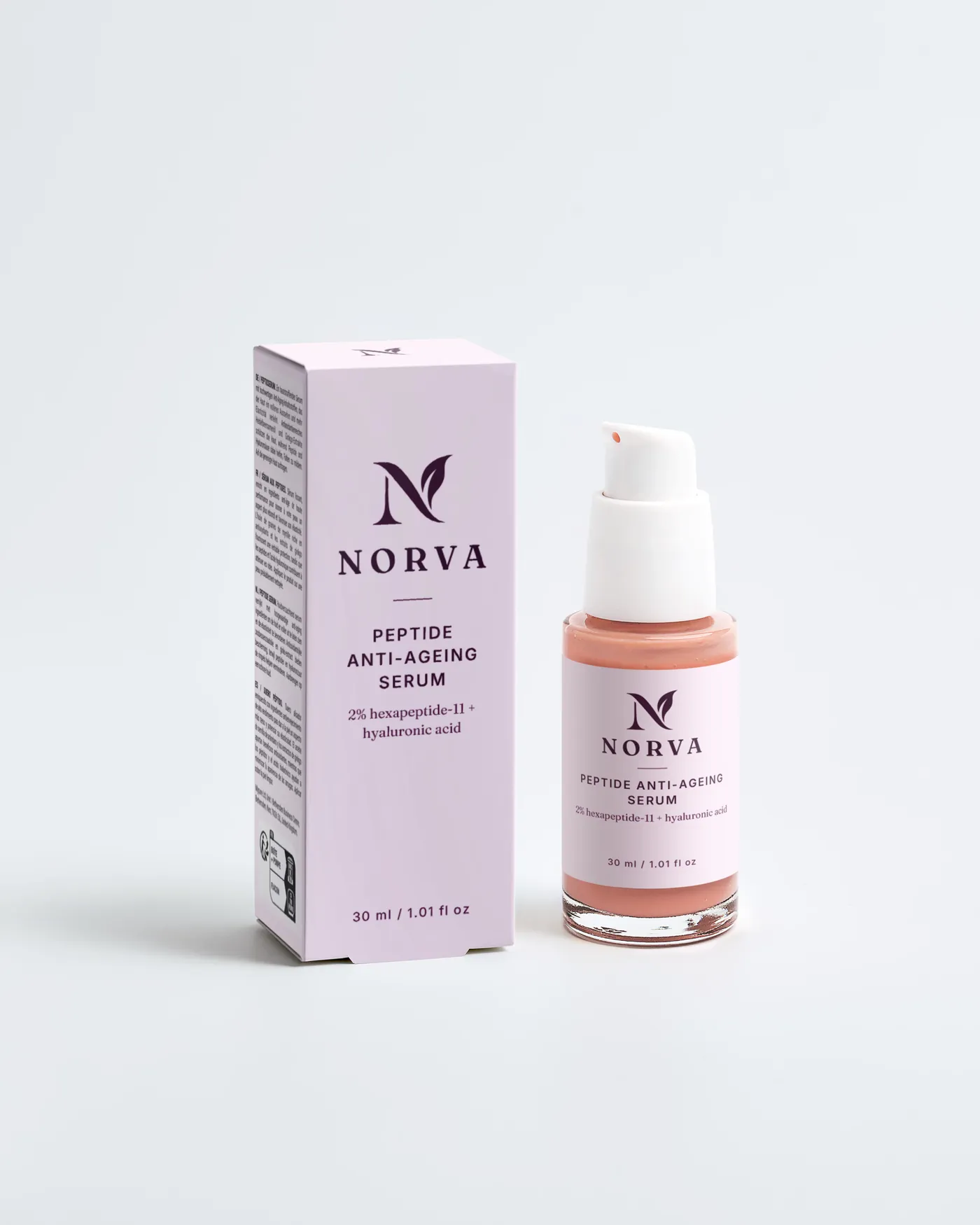
For comparison, our Peptide Anti-Ageing Serum (£30, 30 ml) is the opposite design: one peptide, hexapeptide-11, at a stated 2%. Neither approach is the correct one. They answer different questions, and this page is about how to tell which you want.
The best-known example: what its label actually states
When people search for a multi-peptide serum they nearly always mean The Ordinary's, so we opened its UK product page on 30 September 2026 and wrote down what it says. Only what it says.
Name and price. Multi-Peptide + HA Serum. £15.90 for 30 ml, on offer at £14.31 on the day we looked. A 60 ml size is also listed.
Peptides, as named. Five peptide technologies: SYN-AKE, Matrixyl synthe'6, Matrixyl 3000, ARGIRELOX and acetylarginyltryptophyl diphenylglycine.
Peptides, in the ingredient list. Acetyl hexapeptide-8, pentapeptide-18, palmitoyl tripeptide-1, palmitoyl tetrapeptide-7, palmitoyl tripeptide-38, dipeptide diaminobutyroyl benzylamide diacetate and acetylarginyltryptophyl diphenylglycine. That is seven peptide ingredients behind five technology names.
Percentages. None stated, for the peptides or the hyaluronic acid.
Format. A water-based serum, pH 4.50 to 5.50, listed as alcohol-free, oil-free, silicone-free and vegan, for all skin types, to be applied morning and evening.
Testing. The page says its claims about crow's feet, elasticity and firmness come from an independent efficacy study on 30 individuals over 8 weeks.
Conflicts. The page lists direct acids and direct vitamin C among products not to use it with.
That is a well-made, very fairly priced product, and we say so on our head-to-head comparison. It is also a good teaching example, because everything interesting about multi-peptide serums is visible in those few lines.
Why five "technologies" turn into seven ingredients
Peptides in cosmetics are mostly bought from specialist ingredient suppliers, and suppliers sell them under trade names. A trade name is a brand, not a chemical. One trade-named blend can contain two peptides plus the water, glycerin and solvents they are dissolved in. That is how a label can honestly say "five technologies" on the front and show seven peptide names on the back.
The chemical names are the ones in the INCI list, which is the legally required ingredient list on the pack. When you want to look a peptide up, use the INCI name. "Acetyl hexapeptide-8" will find you published papers. A trade name will mostly find you marketing.
This is also why a percentage on a multi-peptide serum needs care when a brand does give one. A figure attached to a "peptide complex" usually describes the supplier's whole solution, liquid and all. It is a real number. It is not the weight of pure peptide.
Why the ingredient list will not tell you the dose
You might hope to work out the amounts from the order of the ingredients. The labelling rules stop you. Under the cosmetics regulation that applies in the UK, ingredients are listed in descending order of weight, but ingredients at concentrations of less than 1% may be listed in any order after those above 1% (Regulation 1223/2009, Article 19).
Peptides very often sit in that under-1% zone, for reasons the next section shows. So once you are past the water, glycerin and thickeners, the order is up to the brand. A peptide listed fourth is not necessarily present at a higher level than one listed twentieth.
Peptide doses are not comparable with each other
Here is the part that the "more is more" reading of a multi-peptide serum misses. Different peptides are used at wildly different levels, because they were tested at wildly different levels.
Take two of the better-known studies. In one, 93 women aged 35 to 55 used a moisturiser containing a palmitoyl pentapeptide on one side of the face for 12 weeks, and the peptide side showed a significant improvement in fine lines against the plain moisturiser. The amount of peptide was 3 parts per million (Robinson and colleagues, 2005). That is 0.0003%. In another, an emulsion containing 10% of a hexapeptide, the one sold as Argireline, reduced measured wrinkle depth by up to 30% after 30 days on healthy women volunteers (Blanes-Mira and colleagues, 2002).
Three parts per million in one study and 10% in the other. Both are "a peptide". The first was run by the company that makes the product, which is usual in this field, and our guide to reading small skincare trials explains how much weight that deserves.
So counting peptides tells you very little, and comparing percentages across different peptides tells you less. Two percent of one peptide is not "more" than a trace of another in any useful sense. The only fair comparison is each peptide against the level it was studied at, and for most multi-peptide serums you are not given the information to make it.
What "multi" is meant to buy you
A review of controlled peptide studies sorted cosmetic peptides into four groups: signal peptides, carrier peptides, enzyme-inhibitor peptides and neurotransmitter-inhibitor peptides (Gorouhi and Maibach, 2009). Signal peptides are proposed to prompt skin to behave in a younger-looking way. Neurotransmitter-inhibitor peptides are aimed at expression lines. Carrier peptides deliver trace elements such as copper, and we cover those separately in copper peptides versus hexapeptide-11.
Buying a multi-peptide serum is a bet on covering several of those groups at once. It is a reasonable bet. If you do not know which type of peptide your skin will respond to, a blend gives you several tries in one bottle.
What nobody can tell you is whether the blend does more than its best single ingredient would alone. Each peptide has its own small evidence base. Research on combinations is thin, and a trial of "seven peptides at trace levels" against "one peptide at a studied level" has not been published. Anyone who says a multi-peptide serum is definitely better, or definitely worse, is ahead of the evidence.
What the HA adds in a multi peptide HA serum
The "+ HA" is hyaluronic acid, and it is doing the part you feel. Hyaluronic acid holds water at the skin surface, so skin looks plumper within minutes. In a controlled 60-day study of 76 women, creams with 0.1% hyaluronic acid significantly improved skin hydration and elasticity against a plain cream, and the two lowest molecular weights also reduced measured wrinkle depth around the eyes (Pavicic and colleagues, 2011).
This matters for judging any multi peptide HA serum. The good first impression in week one is the humectant, not the seven peptides. Wait until week six or eight before deciding what the peptides have done. Our serum contains hyaluronic acid as well, in two forms, and exactly the same caution applies to it.
One named peptide at a stated percentage: the other approach
A single-peptide serum gives up breadth and gets clarity in return.
Ours uses hexapeptide-11, a six-amino-acid peptide first isolated from yeast extracts and now made synthetically. In a study in Redox Biology it switched on protective and antioxidant-response genes in human skin fibroblasts, and in skin deformation tests on human volunteers it improved skin elasticity (Sklirou and colleagues, 2015). The authors call it promising. It is one study, with the cell work done in a dish.
We print 2% on the label. What that gives you is the ability to check. You know which peptide it is, you can read the paper on it, and you know how much we put in. What it does not give you is proof that our serum beats a blend. We have not run a trial on the finished product, and we would be breaking our own rules if we implied otherwise.
There is also a plain weakness to the single-peptide design. If hexapeptide-11 happens to do nothing much for your face, there is no second peptide in the bottle to fall back on.
Side by side
| | A typical multi-peptide serum | A single stated-peptide serum | |---|---|---| | Number of peptides | Several, from supplier blends | One | | Dose disclosed | Rarely | Yes | | Can you look up the evidence | Peptide by peptide, without knowing the dose | For the one peptide, at a known percentage | | If one peptide does not suit you | Others are still in the bottle | Nothing to fall back on | | What week one feels like | Hydration from the HA | Hydration from the HA | | Typical texture | Light water gel | Varies; ours is richer |
Which should you buy?
You are new to peptides and want to try the category cheaply. A budget multi-peptide serum. The Ordinary's is under £16 and you lose very little if it turns out peptides are not for you.
Your skin is oily or combination. A water-based multi-peptide gel will sit better than a richer serum. Ours has jojoba and seed oils in the base.
Fragrance bothers your skin. Pick one with no fragrance listed. Ours is fragranced, a delicate floral with soft amber notes, and the list includes parfum with linalool, geraniol and citronellol from natural essential oils.
You want to know precisely what you are putting on and at what level. A single-peptide serum with the percentage on the label. That is ours.
Your skin is normal to dry and you dislike watery serums. Ours again. The base has aloe leaf juice, jojoba oil, and blueberry and strawberry seed oils, with 1% ginkgo biloba extract, and it is made for normal, dry and dehydrated skin.
You want a ranked list with prices. We compare three, including where ours loses, in the best peptide serums in the UK.
How to use either kind
Morning and evening, on clean skin, before moisturiser. Two or three pumps, pressed in. Sunscreen in the morning. If the brand lists products not to combine it with, as The Ordinary does for direct acids and direct vitamin C, follow that list for that product.
Give it eight weeks and take a photo at the start. Multi or single, peptides are slow, and a before-and-after picture is the only honest judge.
A note on the name
Search results for "multi peptide serum" also turn up an eye serum and a scalp serum carrying the same words. They are different products for different places. This page is about face serums. An eye-area formula is smaller, lighter and built around different concerns, and a scalp serum is not skincare for your face at all, so check which one is in the basket before you pay.
What ours costs
The Peptide Anti-Ageing Serum is £30 for 30 ml. On a subscription it is £27 every 30 days for one bottle, £51 every 60 days for two, or £72 every 90 days for three. It is made to order in the EU and typically takes 6 to 10 working days to arrive, with free UK and EU delivery on orders over £55 and 30-day returns on unused items.
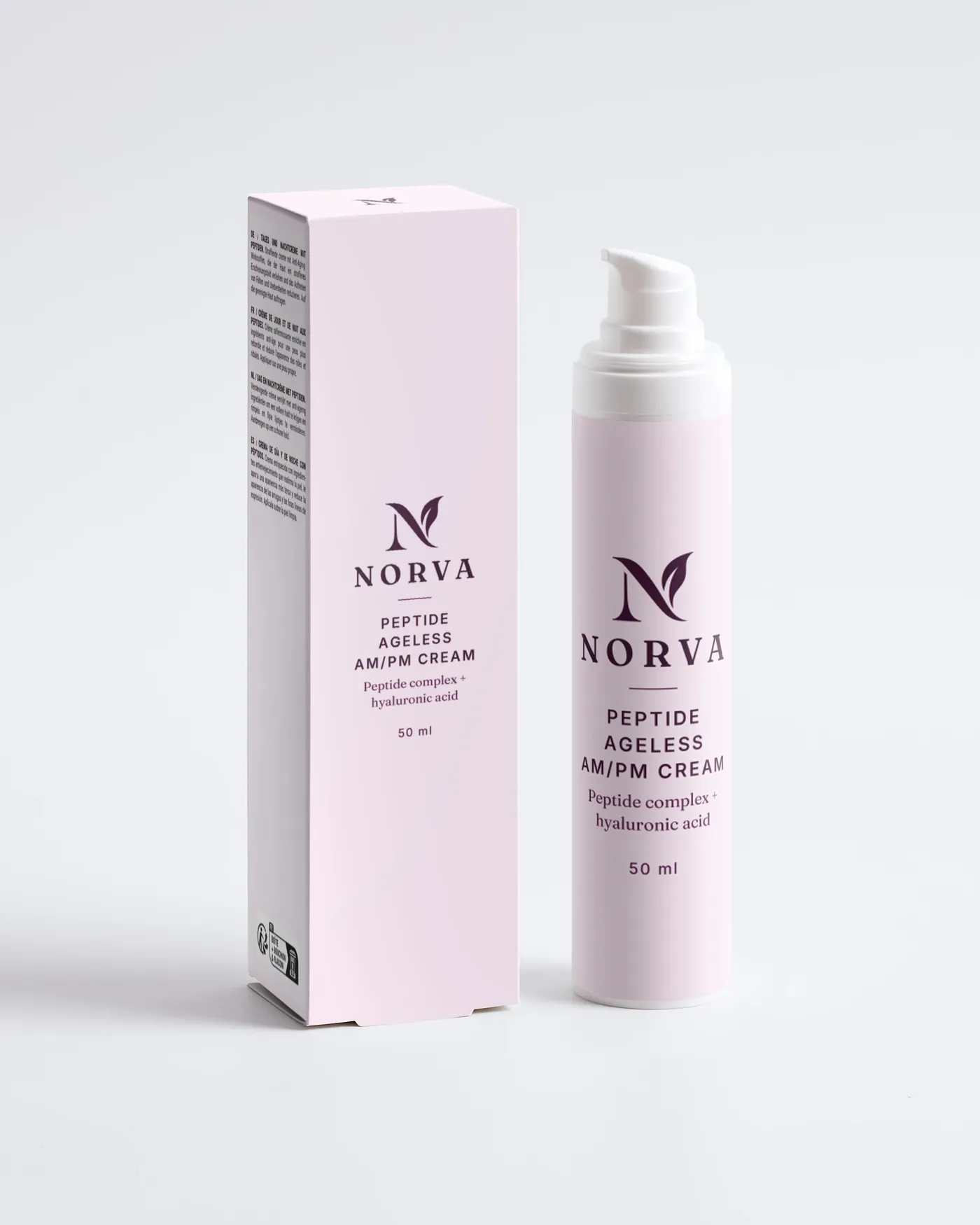
That makes it roughly twice the price of The Ordinary's. We are not going to pretend the difference buys you more peptides, because it buys you fewer. It buys a stated dose, a richer base and a subscription. If those are not things you value, the cheaper serum is the better purchase. If you want the serum with the matching cream and eye cream, The Peptide Routine is £73 for all three, £13 less than buying them separately.
Who this is not for
If you came here wanting to be told that seven peptides beat one, or that one beats seven, we cannot help, because the trial that would settle it does not exist. If you react to fragrance, our serum is the wrong choice and a fragrance-free blend is the right one. If you have a skin condition a GP has named, ask them before adding new products. And if you are not yet wearing sunscreen every morning, that will do more for how your skin ages than any number of peptides.
The short version
A multi-peptide serum contains several peptides, usually from supplier blends, usually with no amounts given. "Five technologies" can mean seven ingredients. The order of the ingredient list will not reveal the dose, and doses are not comparable between peptides anyway: published studies range from a few parts per million to 10%. A blend buys breadth. A single named peptide at a stated percentage buys clarity. Our Peptide Anti-Ageing Serum is the second kind, at £30, and we would rather you bought the first kind than bought ours for the wrong reason. Patch test on the inner arm for 24 hours before first use.
References
- 1.The Ordinary Multi-Peptide + HA Serum UK product page, checked 30 September 2026.
- 2.Gorouhi and Maibach (2009). Role of topical peptides in preventing or treating aged skin. International Journal of Cosmetic Science.
- 3.Robinson et al. (2005). Topical palmitoyl pentapeptide provides improvement in photoaged human facial skin. International Journal of Cosmetic Science.
- 4.Blanes-Mira et al. (2002). A synthetic hexapeptide (Argireline) with antiwrinkle activity. International Journal of Cosmetic Science.
- 5.Sklirou et al. (2015). Hexapeptide-11 is a novel modulator of the proteostasis network in human diploid fibroblasts. Redox Biology.
- 6.Pavicic et al. (2011). Efficacy of cream-based novel formulations of hyaluronic acid of different molecular weights in anti-wrinkle treatment. Journal of Drugs in Dermatology.
- 7.Regulation (EC) No 1223/2009 on cosmetic products (as retained in UK law), Article 19: labelling.
Frequently asked questions
What is a multi-peptide serum?
A serum that contains several different peptides in one formula, usually bought in from suppliers as ready-made blends. The idea is to cover more than one type of peptide at once. Most do not state how much of each peptide is in the bottle.
What does the HA in a multi peptide HA serum mean?
Hyaluronic acid. It is a humectant that holds water at the skin surface, so the serum hydrates and plumps the look of skin straight away while the peptides are given weeks to work.
Is a multi-peptide serum better than a single-peptide serum?
Not automatically. More peptide names does not mean more peptide, and nobody has published a trial comparing blends against a single peptide at a known dose. A multi-peptide serum gives you breadth; a single-peptide serum with a stated percentage gives you clarity.
How many peptides are in The Ordinary Multi-Peptide + HA Serum?
When we checked its UK page on 30 September 2026, The Ordinary named five peptide technologies, and the ingredient list showed seven peptide ingredients. No percentages were given for any of them. It was £15.90 for 30 ml.
Is your peptide serum a multi-peptide serum?
No. Our Peptide Anti-Ageing Serum uses one peptide, hexapeptide-11, at a stated 2%, with hyaluronic acid. It is £30 for 30 ml and it is fragranced. If you specifically want a multi-peptide blend, ours is not one.
Gear for this
Related reading
Copper Peptides vs Hexapeptide-11: What the Label Means
We do not make a copper peptide serum. Here is what GHK-Cu and hexapeptide-11 are, what has actually been studied for each, and which one suits you.
Why a Small 28-Day Skincare Trial Is Weak Evidence: A Worked Example
A 49-person, 28-day study of a peptide cream reported dermatologist-assessed improvements. Using it as a case study in how to read the clinical claims on any product page.