Loading…
Science
Niacinamide Serum: 5%, 10% or 20%? What the Studies Used
10 min read
Walk down any UK skincare aisle and niacinamide serums are lined up by strength like spirits behind a bar: 5%, 10%, 12%, 15%, 20%. The implication is obvious. More must be better. We sell two niacinamide products and neither is above 5%, so we have an interest here, but we also went and read the trials. What they say is more useful than the numbers on the boxes.
Niacinamide serum: 5%, 10% or 20%, which strength should you buy?
For almost everyone, 2% to 5%. That is not a compromise; it is where the published human trials actually sit. The studies that showed niacinamide improving the look of uneven tone, fine lines, sallowness, red blotchiness and oiliness used concentrations between 2% and 5%. No published trial we could find has shown 10% or 20% outperforming 5% on any of those measures. What higher concentrations do reliably increase is the chance of flushing and tingling. So the honest answer to "5, 10 or 20?" is "5, or less", and the rest of this page is the evidence for that.
What niacinamide is
Niacinamide is a form of vitamin B3, also called nicotinamide. It is water-soluble, stable, and one of the best-studied ingredients in cosmetics. A review in the Journal of Cosmetic Dermatology summarised its topical actions as stabilising epidermal barrier function and calming redness in conditions like acne and rosacea (Gehring, 2004). It is popular because it does several modest things at once and plays well with almost everything else.
The percentages on boxes describe how much niacinamide is in the formula by weight. What they do not tell you is how much gets where it needs to go, or whether more arriving does anything extra. For that you need trials.
What percentage did the studies actually use?
Here are the key human and lab studies, and the strength each one tested.
2%: sebum and tanning. In two studies of 2% niacinamide, 100 Japanese participants using it for four weeks showed significantly lower sebum excretion than placebo at weeks two and four, and 30 Caucasian participants showed significantly reduced casual sebum levels after six weeks (Draelos, Matsubara and Smiles, 2006). Separately, 2% niacinamide combined with sunscreen was tested on 120 people over four weeks for its effect on facial tanning (Hakozaki and colleagues, 2002). Two percent.
4%: melasma. In a double-blind, split-face trial of 27 people with melasma, 4% niacinamide on one side was compared with 4% hydroquinone, a prescription-strength lightener, on the other, for eight weeks. Both sides improved. Niacinamide gave good-to-excellent improvement in 44% of cases versus 55% for hydroquinone, with side effects in 18% of niacinamide users against 29% for hydroquinone (Navarrete-Solis and colleagues, 2011). Four percent held its own against a drug.
5%: tone and hyperpigmentation. In a paired study of 18 people with hyperpigmentation, 5% niacinamide in a moisturiser significantly decreased hyperpigmentation and increased skin lightness compared with the vehicle after four weeks. The lab work in the same paper showed niacinamide cut melanosome transfer, the handover of pigment from pigment cells to skin cells, by 35% to 68% (Hakozaki and colleagues, 2002).
5%: the big one. In a 12-week, double-blind, left-right randomised study of 50 women with signs of facial photoageing, 5% niacinamide applied twice daily produced significant reductions in fine lines and wrinkles, hyperpigmented spots, red blotchiness and sallowness, plus improved elasticity, compared with the control side (Bissett, Oblong and Berge, 2005). This is the study every niacinamide product is quietly leaning on. It used 5%.
Barrier lipids: lab and dry skin. In cultured skin cells, nicotinamide raised ceramide synthesis 4.1 to 5.5-fold and increased other barrier lipids too. Applied topically to dry skin it increased stratum corneum ceramides and free fatty acids and reduced water loss (Tanno and colleagues, 2000).
Notice what is missing. There is no 10% arm anywhere in that list, and no 20% arm. The 10% and 20% products on the shelf are not backed by trials at 10% and 20%. They are backed by the 5% trials, with the number doubled or quadrupled for the shelf.
What happens above 5%
The best source here is the cosmetic industry's own safety review. The Cosmetic Ingredient Review panel assessed niacinamide and niacin and concluded both are safe as used in cosmetics and non-toxic at levels far higher than cosmetic products contain. Its human data are the useful part: niacinamide produced no stinging at concentrations up to 10%, and repeated-use tests produced no irritation at concentrations up to 5%. It was not a sensitiser or a photosensitiser (Cosmetic Ingredient Review, 2005).
Read that carefully. Repeated-use irritation was tested to 5%. Stinging was tested to 10%. Nothing in the review covers what happens to a face using 20% twice a day for months. That does not mean 20% is dangerous. It means 20% is an experiment you are running on yourself.
The complaint we hear most about high-strength niacinamide is flushing: warmth and redness for a while after applying. Niacinamide can convert to small amounts of niacin, which is a well-known cause of flushing, and the more you apply, the more there is to convert. If you have ever used a 10% or 20% serum and gone pink, that is likely what happened. It fades. It is also your skin telling you the strength is more than it wants.
For sensitive or barrier-stressed skin, the case for staying at 5% or below is stronger still. Our niacinamide for sensitive skin page goes through this.
Why more does not do more
Skin can only take up so much of any ingredient before the rest sits on the surface or washes off. For an ingredient like niacinamide, which works by nudging skin cells to make more of their own lipids or hand over less pigment, the dose that switches on the effect is what matters, and the 2% to 5% trials suggest that dose is low. Doubling it does not double the nudge. It does double what is left on top of your skin to tingle.
This is also why percentage wars are the wrong way to compare niacinamide products. The better questions are: is it in a base you will use twice a day, is it at a strength with trials behind it, and what else is in the bottle.
If you want a general tool for weighing skincare claims, including the difference between a 12-week trial of 50 people and an "in-house consumer test", our guide to reading small skincare trials is the place.
Our two niacinamide products, and their percentages
We keep both in the evidence range on purpose.
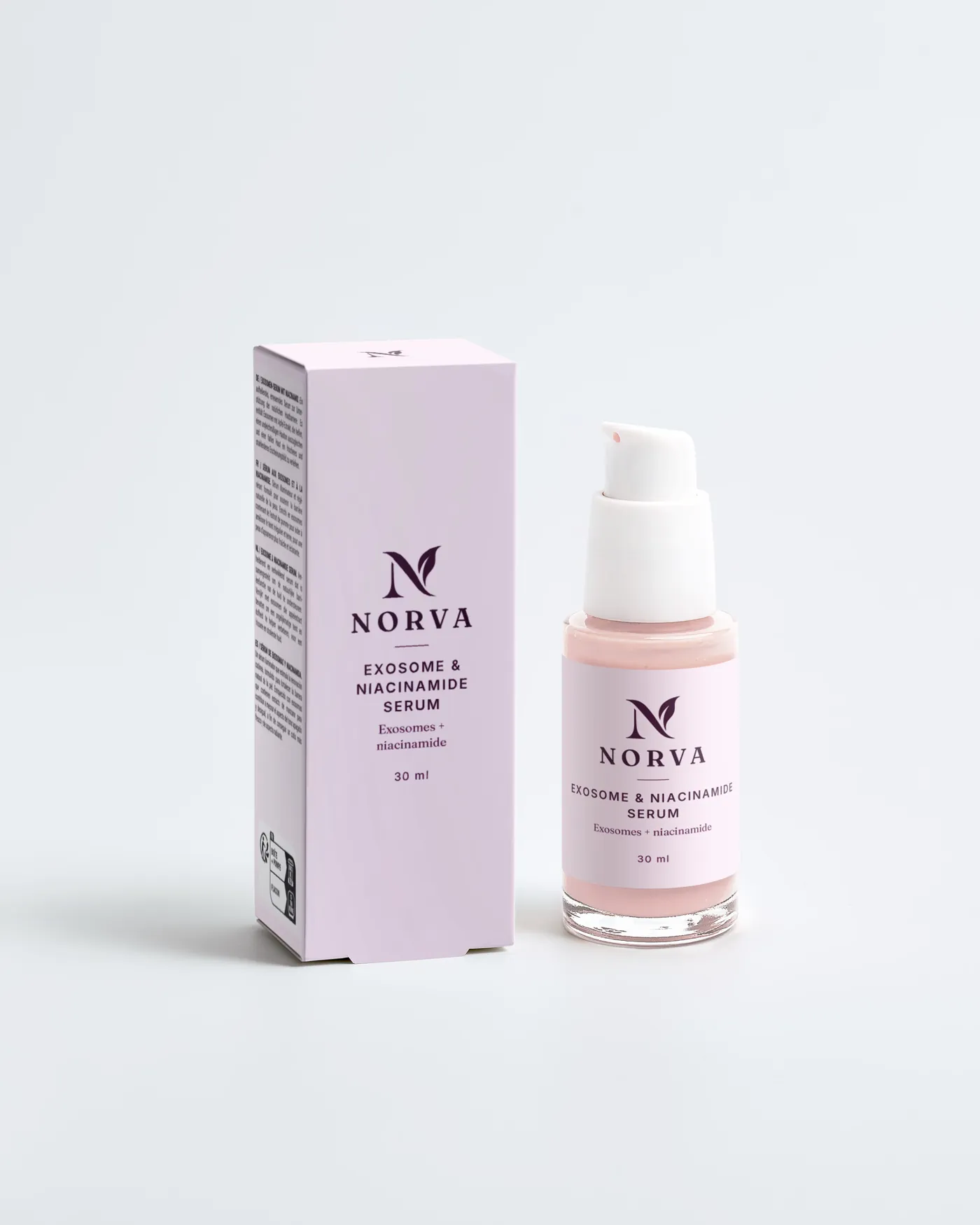
The Exosome & Niacinamide Serum (£30, 30 ml) is a glow serum for dullness and uneven tone. It pairs niacinamide with apple-derived exosomes, a lactobacillus ferment, a small amount of lactic acid, centella asiatica and hyaluronic acid. It is fragrance-free, vegan, and suitable for all skin types including sensitive. We do not publish the exact niacinamide percentage in this formula, but niacinamide sits eighth in the ingredient list, ahead of the jojoba oil and the extracts, which tells you it is a meaningful amount rather than a sprinkle.
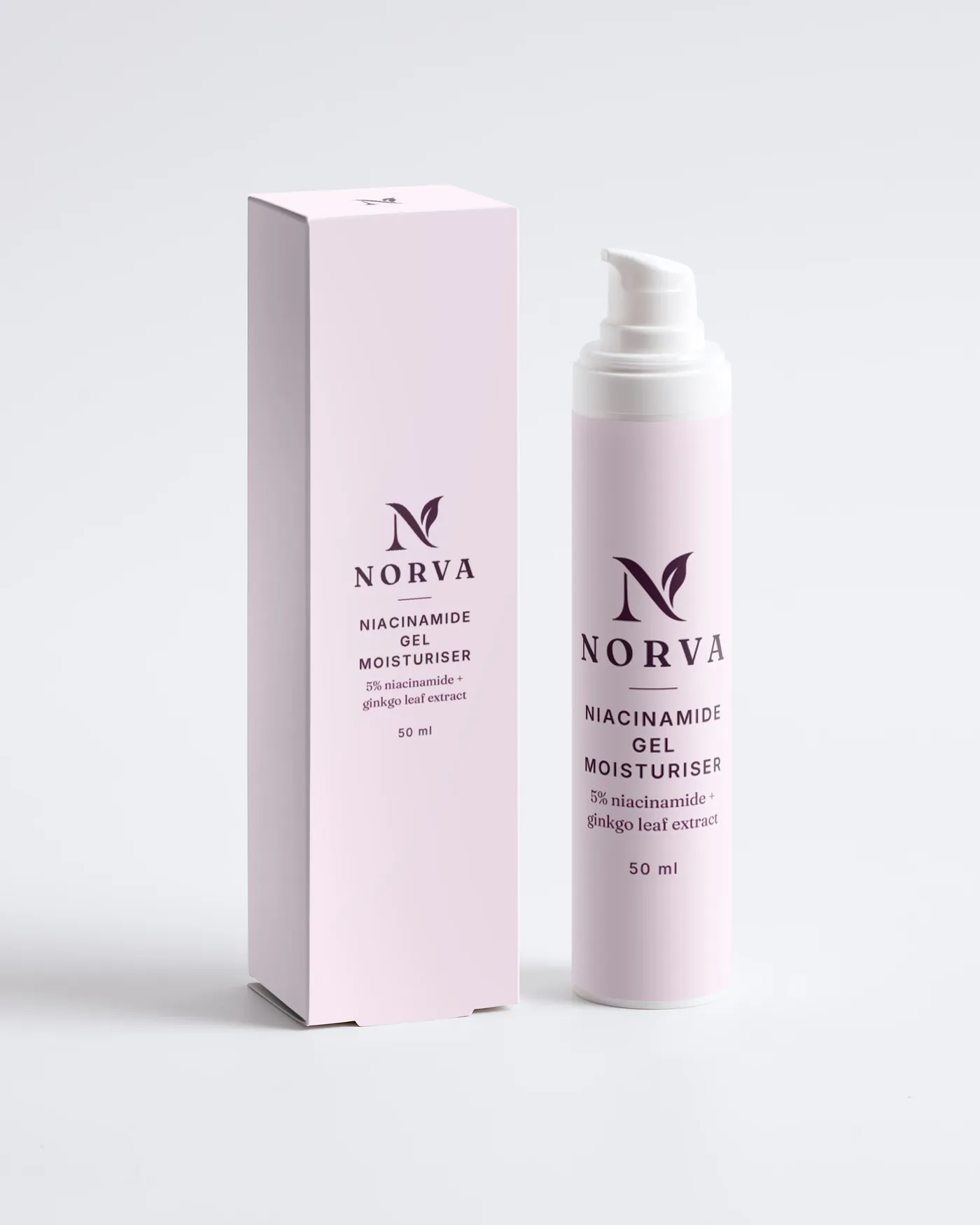
The Niacinamide Gel Moisturiser (£28, 50 ml) states its strength: 5% niacinamide, the same concentration as the Bissett and Hakozaki trials, in a light hydrating gel with ginkgo leaf extract. It is vegan and made for all skin types. It is fragranced, with a light floral scent, and the list includes parfum. If you react to fragrance, the serum is the one to pick.
Both are made in the EU, shipped to order in typically 6 to 10 working days, with free UK and EU delivery over £55 and 30-day returns on unused items. Each can be subscribed to at 10% off every 30 days, 15% off for two every 60 days, or 20% off for three every 90 days. The serum also comes with our Vitamin C Serum as The Glow Duo for £51, which is £9 less than the two separately.
How to use niacinamide at any strength
Twice a day is how the 12-week trials applied it, and it is fine for most people. Once a day if your skin is reactive or you are layering several actives.
Apply to clean skin after cleansing. Serum first, moisturiser second. Niacinamide layers with vitamin C, retinoids, acids and peptides without special handling, which is a large part of its appeal.
Give it twelve weeks. The tone and fine-line results in the key trial were measured at week twelve, not week two. Take a photo in the same light on day one.
If a product tingles or flushes every time, drop the strength rather than pushing through. A 5% product used daily for three months will do more than a 20% one abandoned in week two.
Which strength for which person
Sensitive, redness-prone or barrier-stressed skin. 2% to 5%, fragrance-free. Our Exosome & Niacinamide Serum.
Oily or combination skin wanting less shine and smoother texture. 2% to 5% is where the sebum evidence sits. Either of ours; the gel moisturiser doubles as your daytime moisturiser.
Uneven tone and dark spots. 4% to 5%, twice a day, for twelve weeks, with daily SPF, or nothing you do will hold. The 5% Niacinamide Gel Moisturiser is the stated-strength choice.
Someone who has used 10% happily for a year. Carry on. Tolerance is individual, and if you are not flushing and you like the results, there is no reason to change. Just know the extra 5% is not what the trials tested.
Someone reaching for 20% because 5% "did nothing" in a fortnight. Give 5% twelve weeks first. That is how long the studies ran.
Serum or moisturiser: does the format change the strength you need?
Not really, and this is a useful thing to know because it removes a decision. The trials above delivered niacinamide in moisturiser bases as often as in serums. Bissett's 12-week study used a 5% moisturiser; Hakozaki's hyperpigmentation work used 5% in a moisturiser too. The active does not care whether the bottle says serum or cream. What changes is what else you get.
A niacinamide serum is the choice if you already have a moisturiser you like, or you want to combine niacinamide with other actives in one light step, which is what our Exosome & Niacinamide Serum does with exosomes, ferments and a little lactic acid. A niacinamide moisturiser is the choice if you want fewer steps: one product that hydrates and carries the active, which is our 5% Niacinamide Gel Moisturiser in a nutshell.
Using both together is fine, but it does not "add up" to 10% in any meaningful sense, and if both tingle, drop one. Two products at evidence-range strengths are still evidence-range; the point is consistency, not stacking.
One more thing on labels: a percentage on the front of a moisturiser is the same kind of number as on a serum. Five percent is five percent by weight of the formula. There is no conversion to worry about.
Who this is not for
If you are hoping for a page that tells you 20% is dangerous, this is not it; the safety review found niacinamide non-toxic well above cosmetic levels. If you want a niacinamide product to treat melasma, acne or rosacea, those are conditions, and even though the trials above are encouraging, a GP or dermatologist is the person to talk to. And if you want the strongest possible number on a box for its own sake, we are not the brand for you, and we are fine with that.
The bottom line
The niacinamide trials that matter used 2% to 5%. Nothing published shows 10% or 20% doing more, and human irritation testing stops at 5% for repeated use. Pick a strength in the evidence range, in a base you will use twice a day, and give it twelve weeks. Our Exosome & Niacinamide Serum (£30, fragrance-free) and Niacinamide Gel Moisturiser (£28, 5%) both sit there. Patch test on the inner arm for 24 hours before first use.
References
- 1.Bissett, Oblong and Berge (2005). Niacinamide: a B vitamin that improves aging facial skin appearance. Dermatologic Surgery.
- 2.Hakozaki et al. (2002). The effect of niacinamide on reducing cutaneous pigmentation and suppression of melanosome transfer. British Journal of Dermatology.
- 3.Tanno et al. (2000). Nicotinamide increases biosynthesis of ceramides as well as other stratum corneum lipids to improve the epidermal permeability barrier. British Journal of Dermatology.
- 4.Draelos, Matsubara and Smiles (2006). The effect of 2% niacinamide on facial sebum production. Journal of Cosmetic and Laser Therapy.
- 5.Navarrete-Solis et al. (2011). A double-blind, randomized clinical trial of niacinamide 4% versus hydroquinone 4% in the treatment of melasma. Dermatology Research and Practice.
- 6.Cosmetic Ingredient Review Expert Panel (2005). Final report of the safety assessment of niacinamide and niacin. International Journal of Toxicology.
- 7.Gehring (2004). Nicotinic acid/niacinamide and the skin. Journal of Cosmetic Dermatology.
Frequently asked questions
Is 10% niacinamide better than 5%?
Not according to the published trials. The studies showing improvements in tone, fine lines, sebum and barrier lipids used 2% to 5%. No head-to-head trial has shown 10% doing more than 5%, and irritation testing found no problems up to 5% but only tested stinging, not repeated use, at 10%.
Is 20% niacinamide safe?
The cosmetic safety review found niacinamide non-toxic at levels far above cosmetic use, but its human irritation data covered up to 5% for repeated use and 10% for stinging. Twenty percent is outside what has been studied on faces, and the most common complaint is flushing or tingling.
What percentage niacinamide should a beginner use?
Two to five percent. That is where the evidence sits and where tolerance is best. Our Exosome & Niacinamide Serum and our 5% Niacinamide Gel Moisturiser both sit in this range.
Why does high-strength niacinamide make my face flush?
Niacinamide can convert to a small amount of niacin (nicotinic acid), which causes flushing. The higher the concentration, the more likely the effect. It usually fades within an hour, but it is a sign the strength is more than your skin wants.
Can I use niacinamide twice a day?
Yes. The 12-week trials applied it twice daily. Once a day is fine if you are combining it with other actives or your skin is reactive.
Gear for this
Related reading
Why a Small 28-Day Skincare Trial Is Weak Evidence: A Worked Example
A 49-person, 28-day study of a peptide cream reported dermatologist-assessed improvements. Using it as a case study in how to read the clinical claims on any product page.
Niacinamide Body Serum and the Skinification of Body Care
Why serum-strength actives are moving from face to body, what a body serum can reasonably do, and when a good body lotion is the better buy.