Loading…
Guide
Vitamin C and Peptide Serum: How to Use Them Together
12 min read
Whether a vitamin C and peptide serum can share a routine is one of the questions we are asked most. Someone has a vitamin C serum they like, they have bought a peptide serum, and they have read somewhere that the two should never touch. Now both bottles are sitting on the bathroom shelf and neither is being used.
Can you use a vitamin C and peptide serum together?
Yes. For most products, a vitamin C and peptide serum can be used in the same routine, one after the other or at different times of day. They do different jobs: vitamin C is an antioxidant used to help skin look brighter and more even, and peptides are used to help skin look smoother and firmer over weeks. The one real caveat is strong, acidic L-ascorbic acid serums, which some brands tell you not to layer with their peptide products. If your vitamin C is a gentler derivative, or you use them at different times of day, there is nothing to worry about.
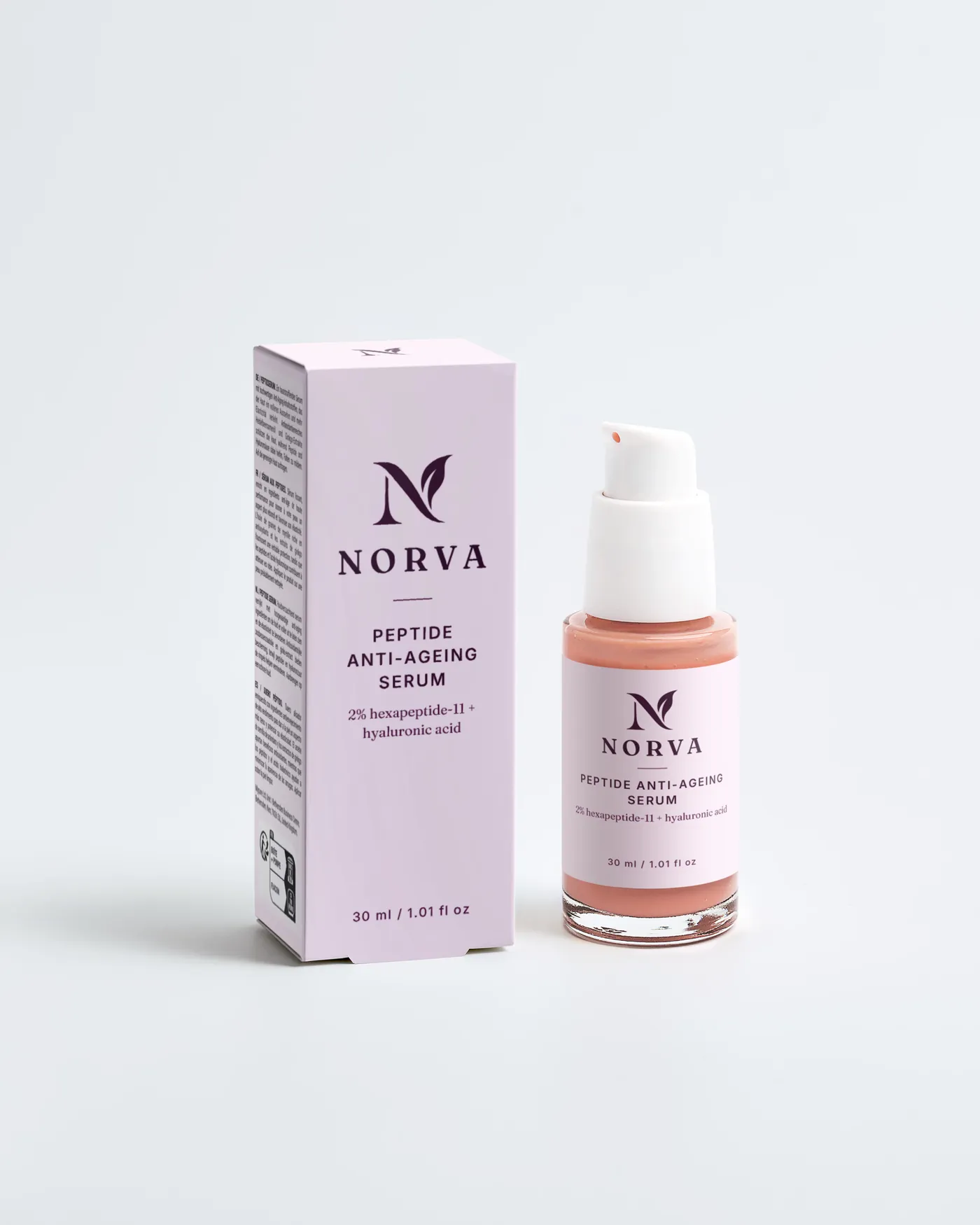
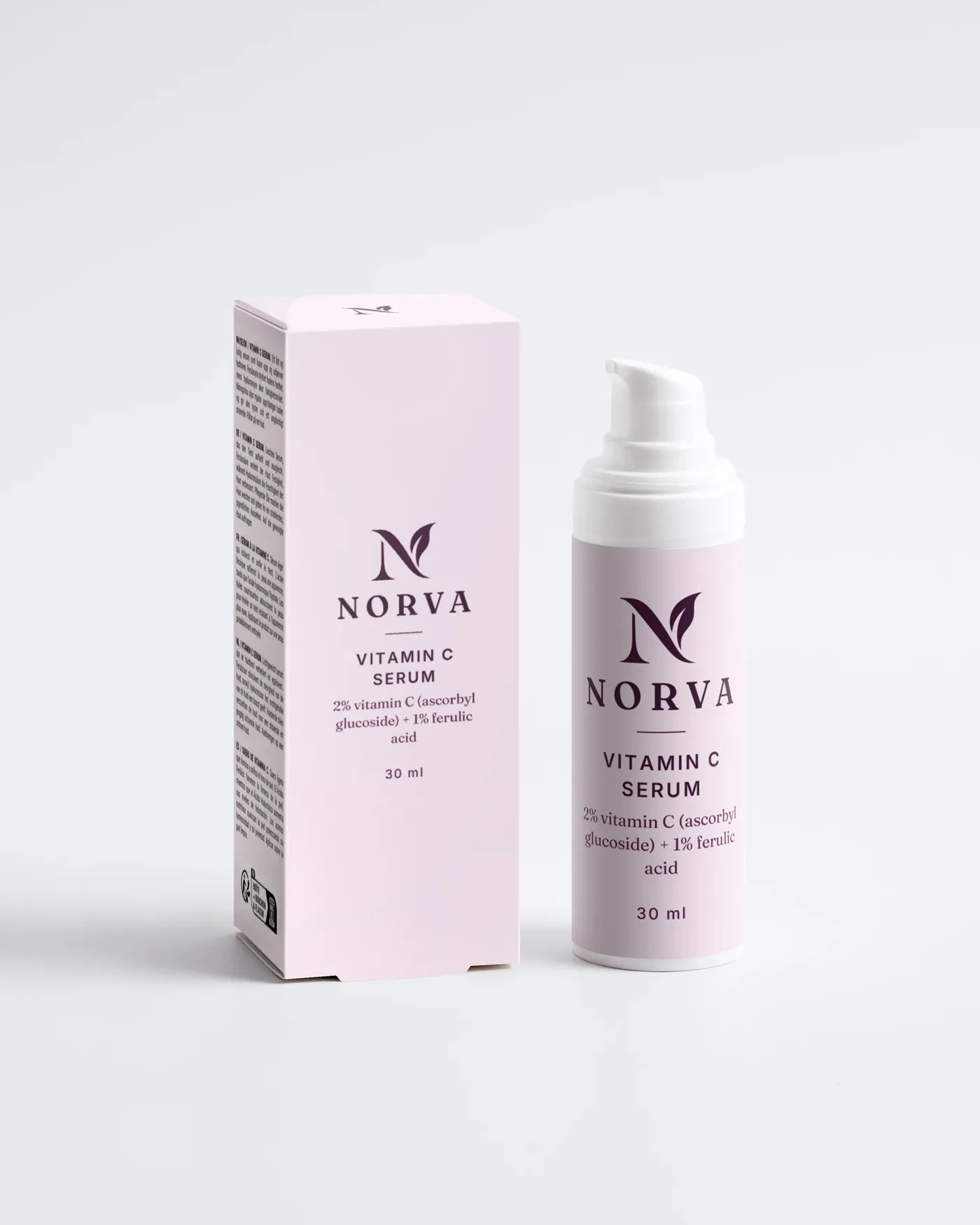
We make one of each. The Peptide Anti-Ageing Serum is £30 for 30 ml with 2% hexapeptide-11, and the Vitamin C Serum is £30 for 30 ml with 2% vitamin C in the form of ascorbyl glucoside. Both fit in one routine. The rest of this page explains where the "never mix them" idea comes from and when it matters.
Where the warning comes from
There are two separate stories tangled together.
The acid story. Pure vitamin C is L-ascorbic acid, and it is fussy. Absorption studies on skin found it has to be formulated at a pH below 3.5 to get in, with uptake levelling off at 20% (Pinnell and colleagues, 2001). A later review by two consultant dermatologists says the same: a pH below 3.5 helps both stability and permeability, a product needs more than 8% to be of biological significance, and above 20% there is no extra benefit and some risk of irritation (Al-Niaimi and Chiang, 2017). A serum at pH 3.5 is properly acidic. Peptide serums tend to be milder; The Ordinary, for example, lists its Multi-Peptide + HA Serum at pH 4.50 to 5.50. The worry is that stacking a strongly acidic layer directly with a peptide layer does neither any favours.
Some brands take that seriously enough to print it. When we checked The Ordinary's UK page for its Multi-Peptide + HA Serum on 30 September 2026, the "do not use with" list included direct acids and direct vitamin C. That is their guidance for their formula, and if you own that serum you should follow it. It is not a universal law about every peptide and every form of vitamin C.
The copper story. The other half of the warning is about copper peptides, a specific type where the peptide carries a copper ion. The advice to keep those away from direct vitamin C is repeated all over the internet, and it is the first thing that comes up when you search this topic. It does not apply to peptides in general. Ours is hexapeptide-11, which contains no copper. If copper peptides are what you are using, our page on copper peptides versus hexapeptide-11 is the one to read.
So the honest summary is narrower than the scary version. Strong L-ascorbic acid plus certain peptide serums, applied at the same moment: follow the brand's label. Everything else: fine.
What vitamin C is doing on your face
Skin naturally holds a lot of vitamin C. A review in Nutrients notes that normal skin contains high concentrations of it, where it supports collagen synthesis and helps with antioxidant protection against UV damage. The same review is frank that how well topical vitamin C works, compared with simply eating enough of it, is poorly understood (Pullar and colleagues, 2017). The dermatologists' review reaches a similar place from the other side: a wide range of possible uses, and clinical studies on topical formulas that "remain limited" (Al-Niaimi and Chiang, 2017).
The best-known lab result is about sun. When ferulic acid was added to a solution of 15% L-ascorbic acid and 1% vitamin E, the mixture became more stable and its protection against simulated sunlight on skin doubled, from about four-fold to about eight-fold (Lin and colleagues, 2005). That is why vitamin C is usually a morning product, worn under sunscreen and never instead of it.
We need to be straight about our own bottle here. Our Vitamin C Serum is not that formula. It has 2% vitamin C as ascorbyl glucoside, which is a derivative, with 1% ferulic acid and 1% sea buckthorn oil. Derivatives are gentler and easier to live with than a 15% acid. They are also less proven: the absorption study above found that the derivatives it tested did not raise skin levels of L-ascorbic acid (Pinnell and colleagues, 2001). Ascorbyl glucoside was not one of the ones tested, so we cannot claim it fails or passes. What we can say is that ours is a mild, everyday brightening serum that helps skin look more even, and that it is not a substitute for a high-strength L-ascorbic acid product if that is what you want.
The upside of mild is that the acid story is not about this kind of product. Those warnings are written about direct L-ascorbic acid at low pH. Ours uses a derivative, so it falls outside them, and it layers with a peptide serum without fuss.
What the peptide is doing
Peptides are short chains of amino acids used to help skin look firmer and smoother. A review of controlled studies sorted them into four groups by how they are thought to work, and found the evidence varies a lot from peptide to peptide (Gorouhi and Maibach, 2009).
Hexapeptide-11, the one in our serum, has a study in Redox Biology behind it. It activated protective and antioxidant-response genes in human skin fibroblasts, and in skin deformation tests on volunteers it improved skin elasticity (Sklirou and colleagues, 2015). One study, and the authors call the peptide "promising". If you want the full background on peptide serums, our UK peptide serum guide covers it; we will not repeat it here.
What matters for this page is that the two ingredients are aimed at different things. Vitamin C is about tone and brightness and daytime antioxidant support. The peptide is about how firm and smooth skin looks after two months. Using both is not doubling up.
The order: vitamin C first, then peptide
Here is the morning routine we would use with both.
- Cleanse. Something gentle. Pat dry.
- Vitamin C serum. Two pumps over the face and neck.
- Peptide serum. Give the first layer half a minute to settle, then two pumps pressed in.
- Eye cream, if you use one.
- Moisturiser.
- Sunscreen. Every morning. In a four-and-a-half-year randomised trial of 903 adults, the daily sunscreen group showed 24% less skin ageing than the group who used it when they chose to (Hughes and colleagues, 2013). Vitamin C sits under sunscreen. It does not replace it.
Evening is simpler: cleanse, peptide serum, eye cream, moisturiser. Peptides are fine twice a day. Vitamin C once, in the morning, is enough.
Vitamin C goes first by convention, mostly, and because of texture. The general rule is thinnest first, and if one of your serums is a watery liquid and the other is milky, the watery one goes on first whichever it is. Our two are both light emulsion serums with similar textures, so we put the vitamin C on bare skin and the peptide serum over it. If your vitamin C is an oil-based or silicone-based formula, it may need to go after the peptide serum instead. Our layering guide has the general rules.
Three ways to split them
Not everyone wants two serums in one sitting. These all work.
Both in the morning, peptide alone at night. The routine above. Best if you want the most from both and do not mind the extra minute.
Vitamin C in the morning, peptide serum at night. The tidiest split, and the one to use if your vitamin C is a strong L-ascorbic acid formula or your peptide serum's label says to keep them apart. They never meet.
Alternate mornings. Vitamin C one day, peptide the next, peptide every evening. Good for skin that gets overwhelmed by layers, or for anyone testing which product is doing what.
If you have a high-strength L-ascorbic acid serum from another brand and you still want both in the morning, leave a few minutes between the two and see how your skin takes it. Stinging or redness that was not there before means go back to the morning and evening split.
Do you actually need both?
Not necessarily.
If your main concern is dullness or uneven tone, vitamin C alone is a reasonable place to start. If it is firmness and fine lines, start with the peptide serum. If it is both, use both. Buying two serums because the internet says a "complete" routine has two is how bathroom shelves fill up with half-used bottles.
It is also worth knowing that the two ingredients already overlap in many products. Our peptide serum lists ascorbyl palmitate, another vitamin C derivative, low in its ingredient list as part of the formula. Our Peptide Ageless AM/PM Cream names vitamin C among its key ingredients. Peptides and vitamin C derivatives have been sitting in the same jars for years without anyone noticing a problem, which tells you how narrow the real conflict is.
What we sell, and what it contains
The Vitamin C Serum is £30 for 30 ml. It has 2% vitamin C as ascorbyl glucoside, 1% ferulic acid, 1% sea buckthorn oil and hyaluronic acid, in a base with jojoba, sweet almond, avocado and rosehip oils. It is vegan, dermatologically tested and suits all skin types. It is fragranced: juicy mandarin with floral notes, from a fragrance plus citrus peel oils, and the list includes limonene, linalool, geraniol and citronellol. If citrus oils bother your skin, this is not your serum.
Our Peptide Anti-Ageing Serum is £30 for 30 ml, with 2% hexapeptide-11, two forms of hyaluronic acid, 1% ginkgo biloba extract, and blueberry and strawberry seed oils. It is made for normal, dry and dehydrated skin. It is fragranced too, a delicate floral with soft amber notes.
Both serums are richer than the water-thin versions you may be used to, because both have plant oils in the base. Dry skin tends to like that. On oily skin, two oil-containing serums plus a cream may be one layer too many, and the morning and evening split will feel better.
Either can be bought on a subscription: £27 every 30 days for one bottle, £51 every 60 days for two, or £72 every 90 days for three. They are made to order in the EU and typically arrive in 6 to 10 working days. Delivery is free in the UK and EU over £55, which the pair together clears, and unused items can be returned within 30 days.
If you want the peptide serum with its matching cream and eye cream, The Peptide Routine is £73 for the three, £13 less than buying them separately, and our peptide skincare routine shows where the vitamin C slots in.
What to expect
Vitamin C is a slow brightener. Give it a couple of months of daily use before deciding whether your skin looks more even, and take a photo at the start. The peptide serum works on a similar clock: hydration from its hyaluronic acid shows in days, and any change in how fine lines look needs six to eight weeks.
Neither of ours should sting. Strong L-ascorbic acid serums are a different matter, and the dermatologists' review notes that concentrations above 20% may irritate (Al-Niaimi and Chiang, 2017). From a derivative serum or a peptide serum, stinging means stop and patch test.
If you start both in the same week and your skin reacts, you will not know which one caused it. Start one, give it two weeks, then add the other.
Mistakes we see
Treating vitamin C as sun protection. It is an antioxidant that goes under sunscreen.
Keeping vitamin C on a sunny windowsill. Vitamin C is known for being unstable, which is the whole reason the ferulic acid study above was done. Keep the cap on and the bottle in a cabinet, away from the radiator and the window.
Applying three serums in a row and wondering why the moisturiser pills. Two is plenty. If a third matters to you, move it to the evening.
Assuming a warning about copper peptides applies to every peptide. It does not.
Who this is not for
If you react to fragrance or to citrus essential oils, skip both of ours; they are fragranced, and the Vitamin C Serum contains citrus peel oils. If you want the strongest published vitamin C evidence, you want a high-percentage L-ascorbic acid serum, which we do not make. If you have melasma, rosacea or persistent redness, speak to a GP or dermatologist before adding actives, because those are conditions and these are cosmetics that help skin look and feel a certain way. And if you are not wearing sunscreen yet, neither serum is the next thing to buy.
The short version
Vitamin C and peptide serum go together fine in nearly every case. Put the vitamin C on first in the morning, the peptide serum over it, then moisturiser and sunscreen, and use the peptide serum again at night. Keep them to separate ends of the day if your vitamin C is a strong acidic formula or your peptide serum's label says so. Our Peptide Anti-Ageing Serum and Vitamin C Serum are £30 each, and a 24-hour patch test on the inner arm before first use applies to both.
References
- 1.Pullar, Carr and Vissers (2017). The Roles of Vitamin C in Skin Health. Nutrients.
- 2.Pinnell et al. (2001). Topical L-ascorbic acid: percutaneous absorption studies. Dermatologic Surgery.
- 3.Al-Niaimi and Chiang (2017). Topical Vitamin C and the Skin: Mechanisms of Action and Clinical Applications. Journal of Clinical and Aesthetic Dermatology.
- 4.Lin et al. (2005). Ferulic acid stabilizes a solution of vitamins C and E and doubles its photoprotection of skin. Journal of Investigative Dermatology.
- 5.Sklirou et al. (2015). Hexapeptide-11 is a novel modulator of the proteostasis network in human diploid fibroblasts. Redox Biology.
- 6.Gorouhi and Maibach (2009). Role of topical peptides in preventing or treating aged skin. International Journal of Cosmetic Science.
- 7.Hughes et al. (2013). Sunscreen and prevention of skin aging: a randomized trial. Annals of Internal Medicine.
- 8.The Ordinary Multi-Peptide + HA Serum UK product page (product conflicts list), checked 30 September 2026.
Frequently asked questions
Can I use vitamin C and a peptide serum together?
Yes, for most products. They do different jobs and are commonly used in the same routine. The one caveat is strong, acidic L-ascorbic acid serums, which some brands advise keeping apart from their peptide serums. Gentler vitamin C derivatives do not raise the same concern.
Which goes first, vitamin C or peptide serum?
Vitamin C first, then the peptide serum, then moisturiser and sunscreen. If one is clearly thinner than the other, the thinner one goes first. Or split them: vitamin C in the morning, peptide serum morning and night.
Should I use vitamin C in the morning and peptides at night?
That works well. Vitamin C is most often used in the morning under sunscreen. Peptides can be used morning and night, so you can also use both in the morning and the peptide serum alone in the evening.
Can I use copper peptides with vitamin C?
That is the combination the warnings online are usually about, and it applies to copper peptides with direct L-ascorbic acid. Our peptide serum uses hexapeptide-11, which is not a copper peptide. Our page on copper peptides versus hexapeptide-11 covers the difference.
What is in your Vitamin C Serum and peptide serum?
The Vitamin C Serum has 2% vitamin C as ascorbyl glucoside, 1% ferulic acid and 1% sea buckthorn oil. The Peptide Anti-Ageing Serum has 2% hexapeptide-11 with hyaluronic acid. Each is £30 for 30 ml, and both are fragranced.
Gear for this
Related reading
Peptide Serum UK Guide: What It Is, Who It Suits, How to Use
A plain UK buyer's guide to peptide serum: what peptides do for how skin looks, what to check on the label, what a fair price is, and how to use one properly.
Copper Peptides vs Hexapeptide-11: What the Label Means
We do not make a copper peptide serum. Here is what GHK-Cu and hexapeptide-11 are, what has actually been studied for each, and which one suits you.
How to Apply Your Skincare, and in What Order
Where each Norva product sits in a morning and evening routine, how to layer a serum under a cream without pilling, and the order for the Peptide Routine, the Barrier Reset Routine and Sensitive Skin Essentials.
Peptide Skincare Routine: When to Use Peptide Serum, AM and PM
When to use peptide serum: morning and night, on clean skin, before cream. A simple peptide skincare routine with the order of serum, eye cream and cream.