Loading…
Guide
Peptide Serum UK Guide: What It Is, Who It Suits, How to Use
11 min read
If you have typed "peptide serum" into Google, you have probably landed on a wall of products that all claim to firm, plump and smooth, priced anywhere from a sandwich to a weekend away. We sell one of them, so read this with that in mind. But we also answer these questions in customer emails every week, and the honest version is more useful than the shouty one.
What is a peptide serum and does it work?
A peptide serum is a light, water-based treatment step that carries one or more peptides onto clean skin before your moisturiser. Peptides are short chains of amino acids, the same building blocks that make up proteins like collagen and keratin. In a cosmetic serum they are used to help skin look smoother and firmer and feel more hydrated over weeks of regular use. That is the whole claim, and it is a cosmetic one: a peptide serum helps skin look and feel a certain way. It does not treat a condition or change what your skin is made of.
Does it work? For some peptides, there is reasonable early evidence. For the category as a whole, the research is thinner than the marketing suggests. A review in the International Journal of Cosmetic Science looked at controlled studies on topical peptides and sorted them into four groups: signal peptides, carrier peptides, enzyme-inhibitor peptides and neurotransmitter-inhibitor peptides (Gorouhi and Maibach, 2009). Most of the studies were small and many were run by the companies that make the peptides. That does not make them wrong, it just means you should keep your expectations at "skin looks a bit smoother" rather than "ten years younger".
The peptide in our serum, and what has been studied
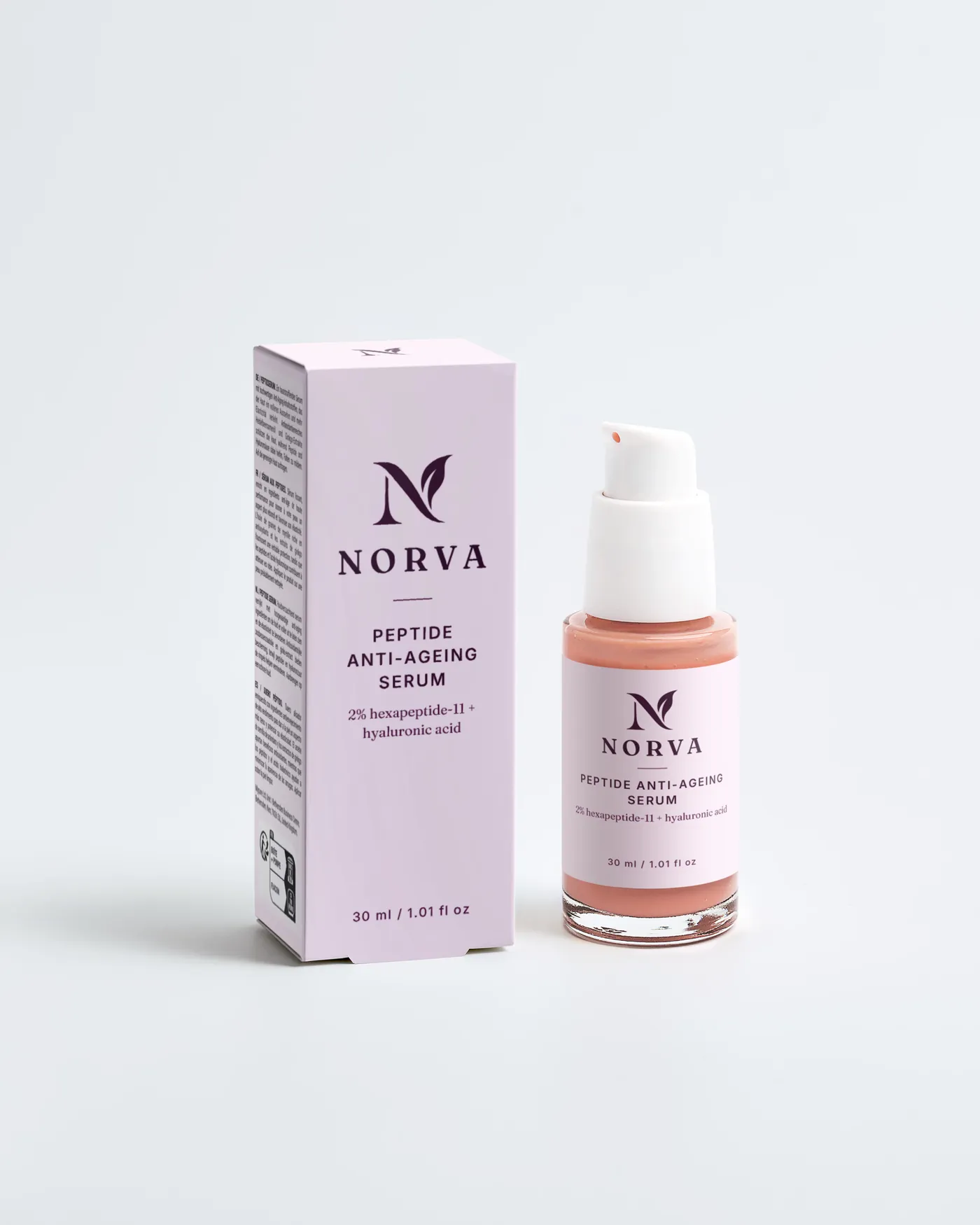
Our Peptide Anti-Ageing Serum (£30, 30 ml) is built around one named peptide at a stated percentage: 2% hexapeptide-11, with hyaluronic acid, 1% ginkgo biloba extract, and blueberry and strawberry seed oils.
Hexapeptide-11 is a six-amino-acid peptide, sequence FVAPFP, that was originally isolated from yeast extracts and is now made synthetically. A study in Redox Biology tested it on human skin fibroblasts, the cells that make collagen, and found that it switched on genes tied to the cell's own housekeeping systems (the proteasome, autophagy, chaperones and antioxidant responses) and protected the cells against oxidative-stress-induced premature ageing in the dish. The same paper reports that in human skin deformation tests, hexapeptide-11 improved skin elasticity (Sklirou and colleagues, 2015).
We want to be clear about what that does and does not tell you. The cell work is lab work. The human elasticity result is a measurement on skin, which is encouraging, but it is one study and the authors describe the peptide as "promising", not proven. We chose it because it has a published mechanism and a published human measurement, which is more than most peptides in the category can say. We did not choose it because it is a miracle.
What the hyaluronic acid is doing
The reason a peptide serum feels like it is working in the first week is usually the hyaluronic acid, not the peptide. Hyaluronic acid is a humectant: it binds water at the skin surface so skin looks plumper and feels smoother almost immediately.
There is decent evidence for this. In a 60-day study of 76 women aged 30 to 60, creams containing 0.1% hyaluronic acid at five different molecular weights all significantly improved skin hydration and elasticity compared with placebo, and the two lowest molecular weights (50 and 130 kDa) also significantly reduced measured wrinkle depth around the eyes (Pavicic and colleagues, 2011). Our serum uses both hydrolysed hyaluronic acid and sodium hyaluronate, which are a smaller and a larger form. We do not publish molecular weights, so we will not claim the wrinkle-depth result for our own formula; we are telling you what the ingredient class has shown.
What to look for on a peptide serum label
Here is what we would check before buying any peptide serum, ours included.
A named peptide. "Peptide complex" tells you nothing. Look for the INCI name: hexapeptide-11, palmitoyl tripeptide-1, acetyl hexapeptide-8, copper tripeptide-1 and so on. If you cannot find one, the brand either does not want you to know or does not know itself.
A stated percentage, where possible. Most brands do not publish one. We print 2% on the label because we think you should be able to compare. Be aware that with multi-peptide blends, a headline like "30% peptide complex" usually describes the whole pre-mixed solution, including its water and glycerin, not 30% actual peptide.
Where the peptide sits in the ingredient list. Ingredients are listed in descending order down to 1%, then in any order below that. Peptides are used at small percentages by nature, so a peptide near the bottom is normal. A peptide listed after the preservatives, though, is a very small amount.
Fragrance. Our serum is fragranced. The scent is a delicate floral with soft amber notes, and the ingredient list includes parfum plus linalool, geraniol and citronellol from natural essential oils. Most people are fine with that. Some are not: a patch-test study of 3,119 adults across five European countries found fragrance contact allergy in around 1.9% of the general population, roughly twice as common in women as men (Diepgen and colleagues, 2015). If you know you react to fragrance, this serum is not the one to test it with. Our Exosome & Niacinamide Serum is fragrance-free if you want a serum without it.
Skin type. Ours is made for normal, dry and dehydrated skin. It has jojoba oil and cetearyl alcohol in the base, so it is a touch richer than a pure water-gel serum. Very oily skin may prefer something lighter.
What a peptide serum costs in the UK
Prices in this category are all over the place. When we checked the UK product pages on 29 September 2026, The Ordinary's Multi-Peptide + HA Serum was £15.90 for 30 ml and Medik8's Liquid Peptides was £59 for 30 ml, and prestige brands go higher still. Price does not track evidence in any way we can detect. It tracks brand, packaging and how many peptide names the label can fit.
Our serum is £30 for 30 ml. If you subscribe, the price drops: every 30 days for one bottle is £27 (10% off), every 60 days for two bottles is £51 (15% off), and every 90 days for three bottles is £72 (20% off). You can cancel whenever you like. Delivery is free in the UK and EU on orders over £55, otherwise it is made to order and shipped from the EU in typically 6 to 10 working days, with 30-day returns on unused items.
If you want the fullest possible picture on price and peptide count, our comparison with The Ordinary's Multi-Peptide + HA Serum spells out where they win and where we do.
How to use a peptide serum
This is simpler than the internet makes it.
- Cleanse. Lukewarm water, a gentle cleanser. Pat dry, but leave skin very slightly damp.
- Apply the serum. Two or three pumps for the whole face and neck. Press it in rather than rubbing.
- Eye cream, if you use one. Peptides are fine around the eyes as long as the product is made for it. Our Peptide Age-Defying Eye Cream (£24, 15 ml) is the one from the same range.
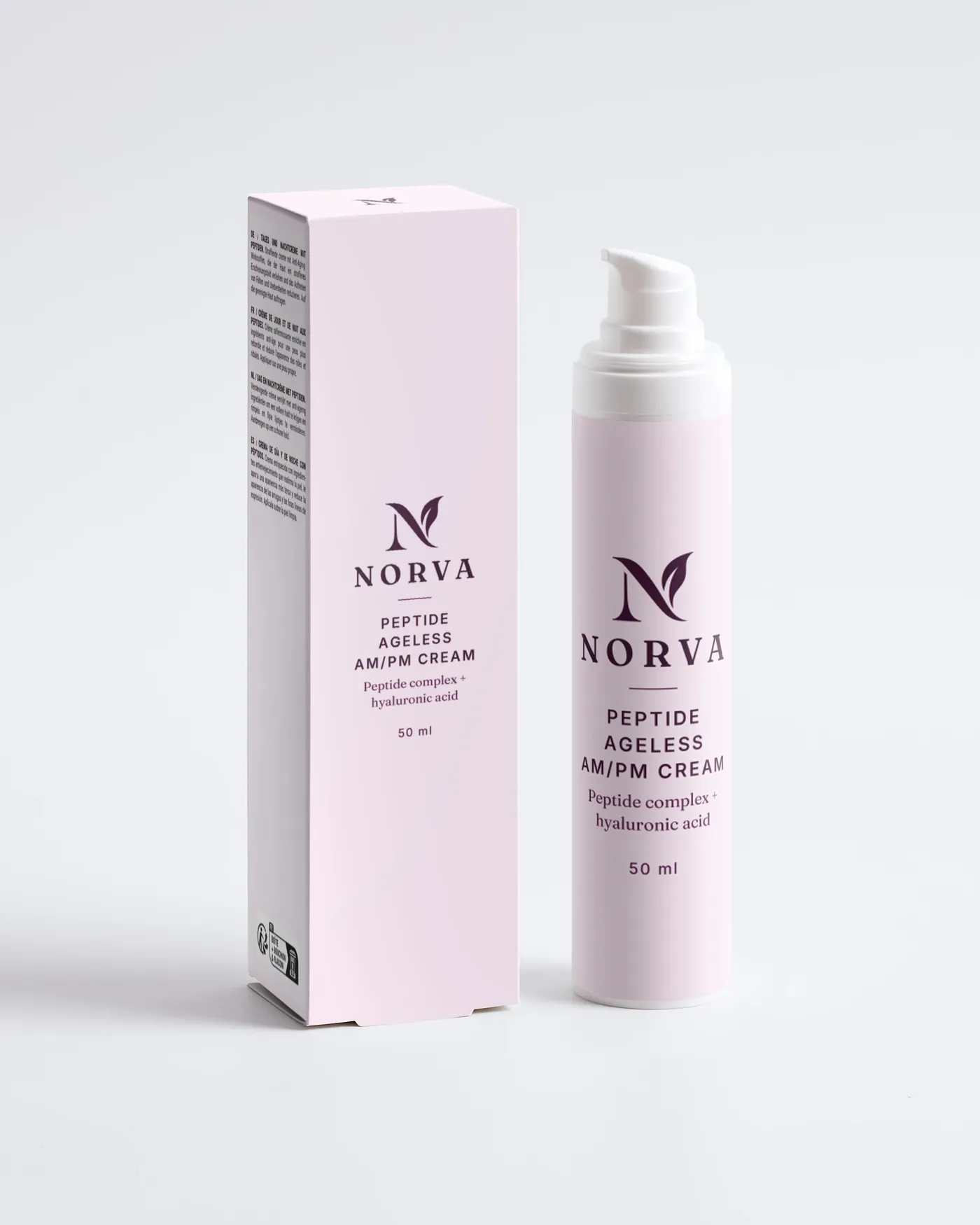
- Moisturiser. The Peptide Ageless AM/PM Cream (£32, 50 ml) is designed to go on top, but any moisturiser you like will do the job.
- Sunscreen in the morning. This is not optional if you care about how your skin ages. In a four-and-a-half-year randomised trial of 903 Australian adults, the group told to use sunscreen every day showed 24% less skin ageing than the group who used it at their own discretion (Hughes and colleagues, 2013). No serum comes close to that.
Twice a day, morning and evening. Peptides do not need an adjustment period the way retinol does, so you can start at full frequency from day one. We keep our own bottle on the bathroom shelf next to the toothbrush, because a serum you forget is a serum that does nothing.
For the fuller version of this, including where vitamin C and retinol alternatives slot in, read our peptide skincare routine and how to apply serums and in what order.
When you will notice something
Week one: skin feels more hydrated and looks a bit plumper. That is the hyaluronic acid.
Weeks two to four: make-up sits better, skin feels smoother to the touch. Some people notice nothing yet and that is normal.
Weeks six to eight: this is the earliest we would judge whether fine lines look softer. Take a photo in the same light on day one and again at week eight, because memory is a terrible instrument.
If nothing has changed by week twelve, it is not the product for you. Use the 30-day return window early if you know within the first fortnight that the texture or scent is wrong for you.
Which peptide serum for which person
You want one clear ingredient at a known dose, and your skin runs normal to dry. Our serum fits. Single peptide, stated 2%, oil-enriched base, made in the EU.
You want as many peptide names as possible for as little money as possible. A budget multi-peptide serum will suit you better, and we say so in our comparison.
You react to fragrance. Not ours. Pick a fragrance-free serum, and if you still want to shop with us, the Exosome & Niacinamide Serum is fragrance-free.
Your skin is very oily. Look for a gel-textured peptide serum without added oils, or use ours only at night under a light moisturiser.
You have a specific skin condition. Peptide serums are cosmetics. If you have rosacea, eczema, acne or anything a GP has named, ask them before adding new products, and treat anything you read online, including this, as general information.
Peptide serum or peptide cream, or both?
People often ask whether they need the serum if they already use a peptide moisturiser, or the other way round. Our honest answer: the serum is the higher-dose step and the cream is the comfort step, and you can run either alone.
A serum is a light, water-based format designed to put an active on skin in a thin layer. That is why it goes first and why it can carry a stated 2% of a single peptide without feeling heavy. A cream has to do a different job, holding water in and keeping skin comfortable, so the peptide sits alongside butters and emollients. Our Peptide Ageless AM/PM Cream is a lightweight day-to-night cream with a peptide complex, hyaluronic acid and vitamins C and E, and it lists hexapeptide-11 too, but we do not state a percentage for it and it is not the product to buy if the peptide is the point.
If you have a moisturiser you love, buy the serum and use it under that. If you want one product and your skin is dry, buy the cream and accept that the peptide is a supporting act. If you want the full set, the routine bundle works out cheaper than either bought piecemeal. There is no version of this where you need three peptide products from three brands.
Who this is not for
We would rather lose a sale than have a bottle sit unused in a drawer. If you are under about 25 with no concerns about fine lines, you do not need a peptide serum; a good moisturiser and sunscreen will do more for you. If you want a product to fix deep, set wrinkles, no serum will, and a consultation with a dermatologist is more honest use of your money. And if you are on a tight budget, spend it on daily SPF first. Come back to peptides once that habit is locked in.
Our peptide serum, one more time
The Peptide Anti-Ageing Serum is £30 for 30 ml, or £27 a month on a plan. 2% hexapeptide-11 with hyaluronic acid, 1% ginkgo extract and blueberry and strawberry seed oils, in a fragranced base with floral and amber notes, made in the EU for normal, dry and dehydrated skin. If you want the serum, day-to-night cream and eye cream together, The Peptide Routine bundles all three for £73, which is £13 less than buying them separately.
Patch test on the inner arm for 24 hours before first use, as with any new skincare. Then give it eight weeks and a before-and-after photo, and decide for yourself.
References
- 1.Sklirou et al. (2015). Hexapeptide-11 is a novel modulator of the proteostasis network in human diploid fibroblasts. Redox Biology.
- 2.Gorouhi and Maibach (2009). Role of topical peptides in preventing or treating aged skin. International Journal of Cosmetic Science.
- 3.Pavicic et al. (2011). Efficacy of cream-based novel formulations of hyaluronic acid of different molecular weights in anti-wrinkle treatment. Journal of Drugs in Dermatology.
- 4.Hughes et al. (2013). Sunscreen and prevention of skin aging: a randomized trial. Annals of Internal Medicine.
- 5.Diepgen et al. (2015). Prevalence of fragrance contact allergy in the general population of five European countries. British Journal of Dermatology.
Frequently asked questions
What does a peptide serum actually do?
Peptides are short chains of amino acids. In a serum they are used to help skin look smoother, firmer and plumper over weeks of use. They are cosmetic ingredients, so the honest promise is about how skin looks and feels, not about changing skin structure.
How much should I pay for a peptide serum in the UK?
Anywhere from about £15 to well over £100 for 30 ml. Price tends to track brand and peptide count rather than proven results. Our Peptide Anti-Ageing Serum is £30 for 30 ml, or £27 on a monthly plan.
How long before a peptide serum shows results?
Hydration and a plumper feel can show within days because of the hyaluronic acid. Any change in how fine lines look needs six to eight weeks of twice-daily use, and it varies from person to person.
Can I use a peptide serum with retinol or vitamin C?
Yes. Peptides layer well with both. Apply the thinnest texture first, then moisturiser, then sunscreen in the morning. If your skin is new to actives, introduce one product at a time.
Does your peptide serum contain fragrance?
Yes. The Peptide Anti-Ageing Serum has a delicate floral scent with soft amber notes. If you react to fragrance, patch test on the inner arm for 24 hours first, or look at our fragrance-free options.
Gear for this
Related reading
Peptide Skincare Routine: When to Use Peptide Serum, AM and PM
When to use peptide serum: morning and night, on clean skin, before cream. A simple peptide skincare routine with the order of serum, eye cream and cream.
How to Apply Your Skincare, and in What Order
Where each Norva product sits in a morning and evening routine, how to layer a serum under a cream without pilling, and the order for the Peptide Routine, the Barrier Reset Routine and Sensitive Skin Essentials.