Loading…
Guide
Skin Barrier Repair Moisturiser: Picking a Day Texture
12 min read
Most advice on barrier repair is about the night cream. Fair enough, since that is where the heavy lipids go. But you spend most of the day awake, and whatever is on your face for those hours has to work under sunscreen, under make-up, in the office heating and on the walk to the station. This page is about that product: the daytime skin barrier repair moisturiser.
What should a skin barrier repair moisturiser do during the day?
A skin barrier repair moisturiser for daytime has three jobs: put water into the outer layer of skin, slow that water leaving, and do both without stinging or pilling under sunscreen. It needs humectants such as glycerin or hyaluronic acid, some emollient to smooth and seal, and a texture you will actually wear at eight in the morning. It does not need to be thick. For skin that is currently tight or reactive, fragrance-free is the safer choice. Which texture you pick, gel, lotion or cream, depends on how oily your skin is, not on how damaged the barrier feels.
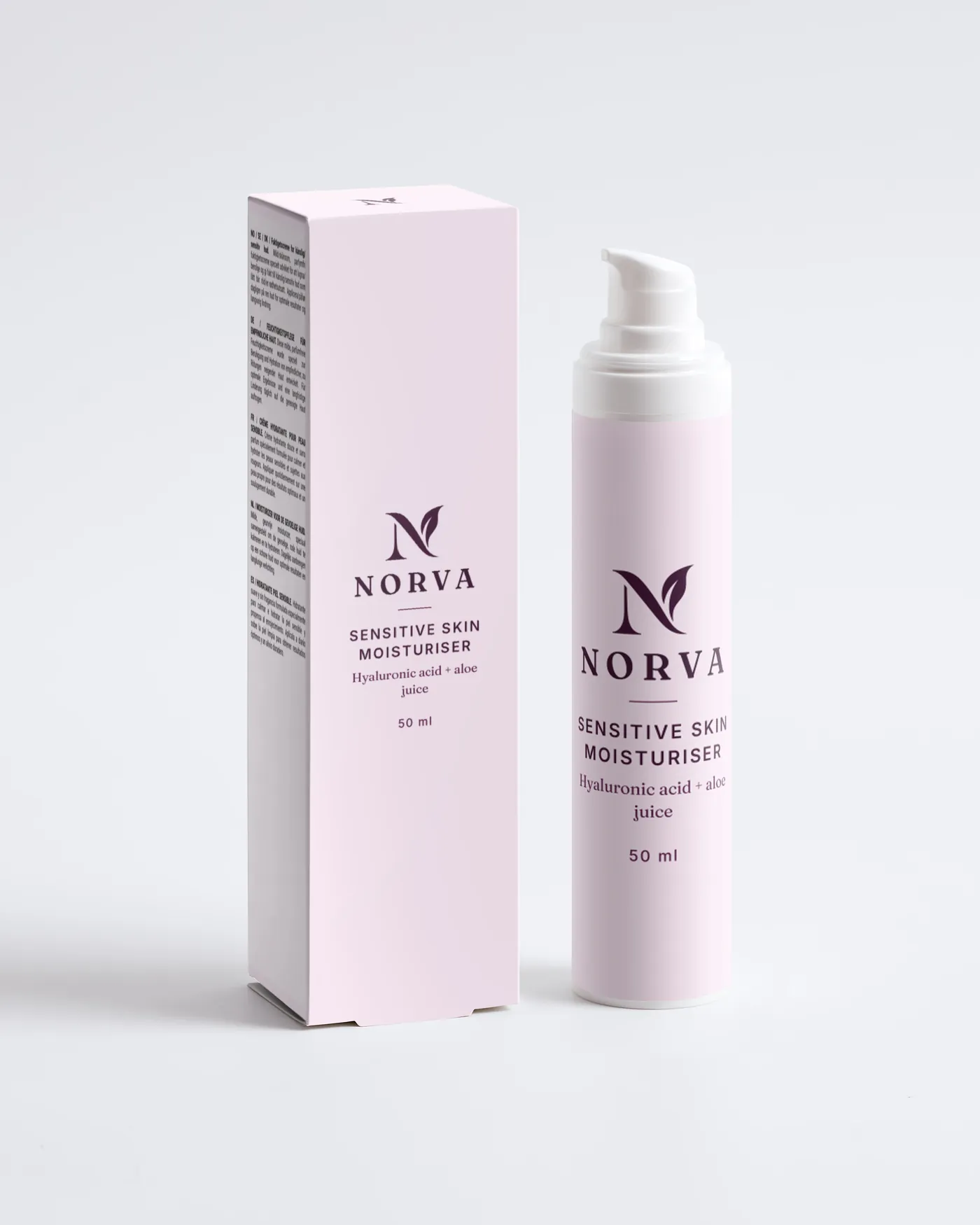
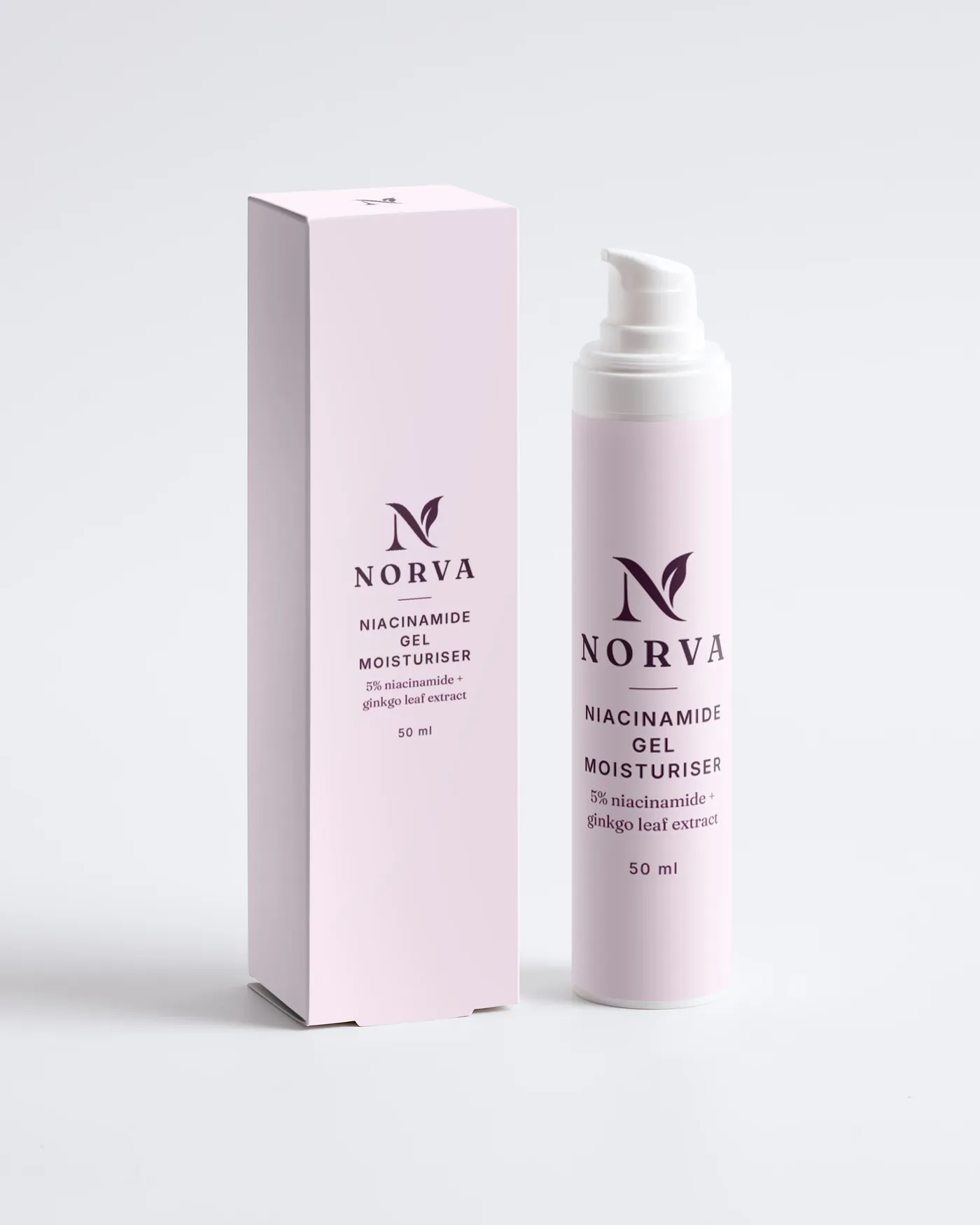
We make two day moisturisers that fit different versions of this. The Sensitive Skin Moisturiser is £32 for 50 ml, fragrance-free, for sensitive and dehydrated skin. The Niacinamide Gel Moisturiser is £28 for 50 ml, with 5% niacinamide, for oilier skin that has stopped stinging. They are not interchangeable, and a lot of this page is about telling which one you are.
Why daytime is a different problem from night
At night you can wear anything. A thick ceramide cream, a layer of petroleum jelly over it, a shiny face on the pillow. Nothing has to go on top and nobody is looking. If the night step is what you are after, our guide to choosing a skin barrier repair cream covers it, and we will not repeat it here.
Daytime has constraints. Sunscreen has to go over the moisturiser and stay put. Make-up may go over that. You will touch your face, sweat a bit, sit in dry air. A moisturiser that is perfect at 10 pm can be a greasy, pilling mess at 8 am.
So the day product is a compromise by design. It gives up some richness to be wearable, and the night cream makes up the difference. People who try to use one heavy cream for both often end up skipping the morning application because it feels horrible under SPF, and a skipped moisturiser repairs nothing.
What a moisturiser is actually made of
Dermatology sorts moisturiser ingredients into classes by what they do: occlusives, humectants, emollients and protein rejuvenators, with most commercial moisturisers using components from several classes at once (Lynde, 2001).
Humectants bind water. Glycerin, hyaluronic acid, sodium PCA. These are the daytime workhorses, because they hydrate without weight.
Emollients smooth the surface and fill the gaps between skin cells. Plant oils like jojoba, and esters with names like coco-caprylate.
Occlusives sit on top and slow water leaving. Petrolatum is the classic. Butters and waxes do a lighter version.
The hydration part is not cosmetic fluff. A review of how the outer skin layer keeps itself in order found that each step in forming an effective moisture barrier, from strengthening the surface cells to processing lipids to producing the skin's natural moisturising factor, is influenced by how hydrated that layer is (Rawlings and Harding, 2004). Keeping water in the skin through the day is part of how the barrier rebuilds. It is not only a comfort measure.
A day moisturiser leans on humectants and light emollients. A night cream leans on emollients and occlusives. Same ingredients, different proportions.
Gel, lotion or cream: choosing the texture
This is the decision most people get wrong, usually by buying the thickest thing on the shelf because their skin feels damaged.
Gel. Mostly water, held together with a gelling agent, with humectants and sometimes an active. Almost no oil. It feels cool, sinks in within seconds and leaves a matt finish. Gels suit oily and combination skin, humid weather, and anyone who hates the feel of cream. The weakness is that a gel adds water but very little to keep it there. On dry skin, a gel alone can leave you tighter by lunchtime than when you started.
Lotion or light cream. An emulsion of water and oil with more water than oil. It has humectants plus enough emollient to slow water loss, and it still sits comfortably under sunscreen. This is the middle of the road, and it is where most people with a stressed barrier should be during the day.
Rich cream. More oil, often butters and waxes. Comfortable on very dry skin and in cold weather. Under sunscreen it can pill or slide, and on oily skin it can feel smothering. For most people this is the night texture.
A simple way to choose: wash your face, leave it bare for half an hour, and see what happens. Shiny across the forehead and nose means gel or a very light lotion. Comfortable means lotion. Tight, with fine flakes, means light cream by day and a rich one at night.
One more thing. "How damaged my barrier feels" and "how oily my skin is" are separate. Oily skin can have a stripped barrier; it is common after too many acids. That person needs a light, non-stinging moisturiser, not a heavy one.
What to avoid in a day moisturiser while skin is reactive
A review of moisturisers in dry skin and barrier disorders makes a point that tends to surprise people: some formulations can make the skin's condition worse, and the ingredients usually thought of as inactive, such as emulsifiers, may have more effect on the barrier than was once assumed (Loden, 2003). A moisturiser is not harmless by default. So, while your skin is stinging:
Fragrance. Most people tolerate it. Some do not: a patch-test study of 3,119 adults in five European countries put fragrance contact allergy at around 1.9% of the general population (Diepgen and colleagues, 2015). On a compromised barrier, it is one more unknown. Go fragrance-free until things settle. Our guide to fragrance-free moisturisers explains how to read a label for it.
High alcohol content. Alcohol high in an ingredient list helps a gel dry fast and feel weightless. On intact oily skin that is pleasant. On a barrier that is already stinging, it is likely to sting more.
Exfoliating acids and strong actives built in. A day moisturiser with glycolic acid or a high-percentage active is an active treatment wearing a moisturiser's label. Save those for later.
Anything that stings. This is the real test and it overrides every ingredient rule. If a product stings on application for more than a few seconds, or your skin feels tighter an hour later, it is wrong for you at the moment, whatever the box says.
Where niacinamide fits
Niacinamide is the one active with a good claim to a place in a barrier moisturiser. In laboratory work on human skin cells, it increased the production of ceramides several-fold, along with free fatty acids and cholesterol, and when applied to dry skin it raised ceramide and free fatty acid levels in the outer layer and reduced water loss through the skin (Tanno and colleagues, 2000). A later review sums up topical niacinamide as having a stabilising effect on barrier function, seen as lower water loss and better moisture content in the outer layer (Gehring, 2004).
It is also well tolerated at sensible strengths. A safety review reports that clinical testing produced no stinging at concentrations up to 10% and no irritation in use tests at up to 5% (Cosmetic Ingredient Review, 2005). That was on normal skin. A stripped barrier can tingle with things normal skin ignores, so if a niacinamide product stings you, stop and come back to it in a few weeks. For more on strengths, see niacinamide at 5%, 10% or 20%.
Our two day moisturisers, compared honestly
| | Sensitive Skin Moisturiser | Niacinamide Gel Moisturiser | |---|---|---| | Price and size | £32, 50 ml | £28, 50 ml | | Texture | Lightweight cream, non-greasy finish | Water gel | | Key ingredients | Hyaluronic acid, aloe juice, jojoba oil, sodium PCA | 5% niacinamide, ginkgo leaf extract | | Fragrance | Fragrance-free | Fragranced, light floral | | Alcohol in the ingredient list | No | Yes, listed second | | Made for | Sensitive and dehydrated skin | All skin types | | Best use in barrier repair | From day one, while skin is reactive | Later, once stinging has stopped |
The Sensitive Skin Moisturiser is the one we would hand to someone whose face stings when they wash it. It is fragrance-free. The base is aloe leaf juice, glycerin and jojoba oil, with sodium PCA and two forms of hyaluronic acid as humectants and light esters as emollients. It is lightweight with a non-greasy finish, which is what makes it a day product. It helps reduce the look of redness and supports the skin's natural barrier.
What it is not: a ceramide cream. There are no ceramides in the ingredient list. It hydrates and cushions, and it is gentle, but the lipid-replacement job belongs to a night cream. We would pair it with one.
The Niacinamide Gel Moisturiser has the stated 5% niacinamide, which is the ingredient with the barrier evidence above, in a very light gel. On paper that sounds like the ideal barrier moisturiser. In practice we would not start with it on reactive skin, for two reasons that are on its own label: alcohol is the second ingredient, and it is fragranced with a light floral scent. It is a good daily moisturiser for oily and combination skin that wants niacinamide without a separate serum. It is the right choice after the stinging stage, not during it.
Both are made in the EU. Both can be bought on a subscription at 10% off for one every 30 days, 15% off for two every 60 days or 20% off for three every 90 days.
How to use a barrier repair moisturiser in the morning
- Cleanse gently, or not at all. If your skin is dry and reactive, a rinse with lukewarm water is enough in the morning.
- Apply to damp skin. Pat your face so it is no longer dripping, then moisturise within a minute. Humectants need water to hold.
- Use enough. A pea to a hazelnut for face and neck. Reactive skin is often under-moisturised because people are nervous of putting anything on it.
- Wait a minute, then sunscreen. Let the moisturiser settle so the SPF does not pill. Sunscreen is not optional on a stressed barrier, or on any face: in a randomised trial of 903 adults, daily sunscreen users showed 24% less skin ageing over four and a half years than discretionary users (Hughes and colleagues, 2013).
- Reapply moisturiser if you need to. A small amount pressed over dry patches at lunchtime is fine, make-up or not.
That is the entire morning. No toner, no serum, no actives until your skin has been calm for a few weeks. The full picture of what to stop and restart is in what skin barrier repair means.
Pairing day and night
The day moisturiser holds the line. The night cream does the rebuilding. A sensible pairing from our range while skin is reactive is the Sensitive Skin Moisturiser in the morning and a richer cream in the evening.
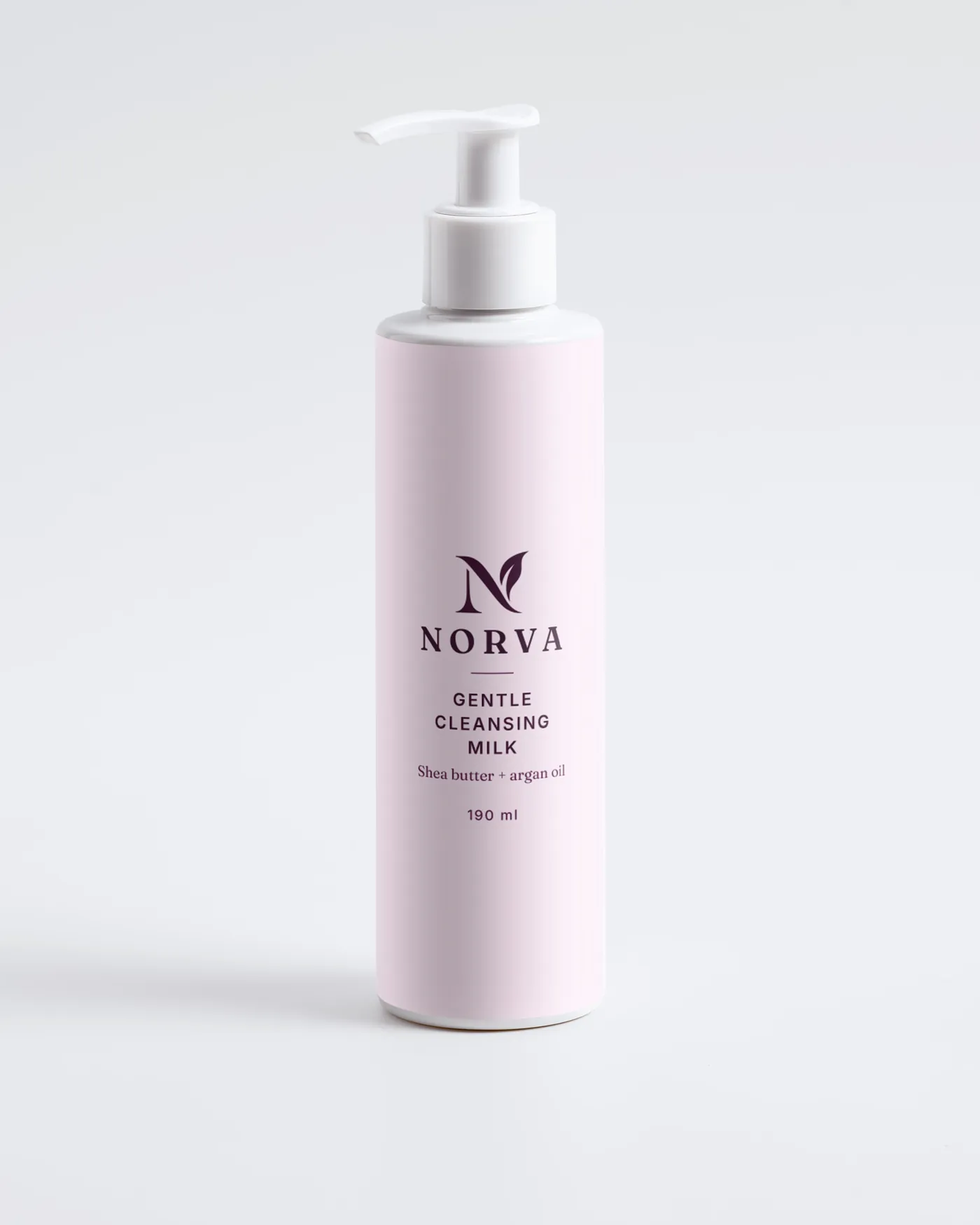
If fragrance is a concern, Sensitive Skin Essentials puts the Sensitive Skin Moisturiser together with the Sensitive Skin Overnight Cream, which is made without added fragrance, and the Gentle Cleansing Milk, for £73. That is £13 less than the three separately and over the £55 line for free UK and EU delivery. Be aware the cleansing milk in that set is fragranced; the two creams are the fragrance-free part.
For ceramides at night, when fragrance is not a problem for you, the Ceramide Barrier Night Cream is the richer option. It is fragranced.
Orders are made to order in the EU and typically arrive in 6 to 10 working days, with 30-day returns on unused items.
How to tell it is working
The first sign is an absence. Your moisturiser stops stinging when it goes on. Then the tight feeling after washing eases. Then the flaky patches around the nose and mouth smooth out, and sunscreen stops catching on them.
We are not going to put a number of days on that. It depends on what stripped your skin, how long it went on, and whether you have really stopped doing it. What we can say is that a moisturiser will not out-repair a routine that is still damaging the barrier. If you are using this by day and an exfoliating acid every other night, the acid is winning.
If several weeks of gentle care bring no improvement, or skin is cracked, weeping, very itchy or sore, see a pharmacist or GP. That is past what a cosmetic moisturiser is for.
Who this is not for
Anyone with eczema, rosacea or dermatitis should know that a cosmetic moisturiser may help skin feel more comfortable but it is not a treatment, and the emollients a GP or pharmacist recommends should come first. If your skin is very dry and cracked, a light day moisturiser will not be enough by itself, and you need the night cream and possibly an ointment as well. If you want ceramides in your day product specifically, neither of ours has them. And if your skin is comfortable, not tight and not stinging, you do not need a "barrier repair" anything. An ordinary moisturiser and sunscreen are doing the job already.
The short version
A daytime skin barrier repair moisturiser should hydrate, hold that water in and sit quietly under sunscreen. Choose the texture by how oily your skin is: gel for oily, lotion or light cream for most, rich cream for very dry or for night. Go fragrance-free and alcohol-free while skin stings. Our Sensitive Skin Moisturiser, £32, is the fragrance-free pick for that stage, and the Niacinamide Gel Moisturiser, £28, is for oilier skin once things have calmed down. Patch test either on the inner arm for 24 hours before first use.
References
- 1.Lynde (2001). Moisturizers: what they are and how they work. Skin Therapy Letter.
- 2.Rawlings and Harding (2004). Moisturization and skin barrier function. Dermatologic Therapy.
- 3.Loden (2003). Role of topical emollients and moisturizers in the treatment of dry skin barrier disorders. American Journal of Clinical Dermatology.
- 4.Tanno et al. (2000). Nicotinamide increases biosynthesis of ceramides as well as other stratum corneum lipids to improve the epidermal permeability barrier. British Journal of Dermatology.
- 5.Gehring (2004). Nicotinic acid/niacinamide and the skin. Journal of Cosmetic Dermatology.
- 6.Cosmetic Ingredient Review Expert Panel (2005). Final report of the safety assessment of niacinamide and niacin. International Journal of Toxicology.
- 7.Diepgen et al. (2015). Prevalence of fragrance contact allergy in the general population of five European countries. British Journal of Dermatology.
- 8.Hughes et al. (2013). Sunscreen and prevention of skin aging: a randomized trial. Annals of Internal Medicine.
Frequently asked questions
What is the best moisturiser for skin barrier repair during the day?
One that is light enough to sit under sunscreen, contains humectants and emollients, and does not sting. For skin that is currently reactive, choose fragrance-free. Gel textures suit oily skin, lotions suit most, and richer creams suit dry skin or the evening.
Is a gel moisturiser enough to repair the skin barrier?
It can be for oily or combination skin that is only mildly stressed. Gels are mostly water and humectants, so they hydrate well but add little oil. If your skin is dry, tight or flaking, use a lotion or cream by day and keep the gel for when things have settled.
Do I need a different moisturiser for day and night?
Not strictly, but it helps. A lighter moisturiser works better under sunscreen and make-up in the morning, and a richer cream with more lipids does the heavier repair work at night when nothing has to sit on top of it.
Should a barrier repair moisturiser be fragrance-free?
While your skin is stinging or flaking, yes, that is the cautious choice. Fragrance is one less thing for reactive skin to deal with. Once your skin is calm again, a fragranced moisturiser is fine for most people.
Which of your moisturisers is for a damaged skin barrier?
The Sensitive Skin Moisturiser, £32 for 50 ml, is fragrance-free and made for sensitive and dehydrated skin, so it is our day pick while skin is reactive. The Niacinamide Gel Moisturiser, £28, has 5% niacinamide but contains alcohol and fragrance, so it suits oilier skin once stinging has stopped.
Gear for this
Related reading
Skin Barrier Repair Cream: How to Choose One That Works
What a skin barrier repair cream should contain, what the ceramide evidence says, how to use one at night, and where our Ceramide Barrier Night Cream fits in.
Skin Barrier Repair: What It Means and How to Do It
How to repair your skin barrier, plainly: what the barrier is, what damages it, the signs, the ingredients with evidence, and a routine that works in weeks.
Fragrance-Free Moisturiser UK: How to Choose and What to Check
A UK guide to buying a fragrance-free moisturiser: fragrance-free vs unscented, how to read the label, who needs one, and which of our products truly qualify.
Niacinamide Serum: 5%, 10% or 20%? What the Studies Used
Should you buy 5%, 10% or 20% niacinamide serum? We read the published trials to see which strengths were actually tested, and what happens above 5%.