Loading…
Resource
Should I use a peptide eye serum or an eye cream?
11 min read
Eye products come in two textures and the shops do not explain the difference. One tube says peptide eye serum, one says eye cream, and both are 15 ml. We make a peptide eye cream and not a peptide eye serum, so you know which way we lean. We will still tell you when the serum is the better buy.
Should I use a peptide eye serum or an eye cream?
Use a peptide eye serum if the skin around your eyes is oily, puffy in the mornings, or you need something thin that sits under concealer. Use a peptide eye cream if the area is dry, crepey or lined, or you are past your mid-thirties and moisturiser never seems to last there. The peptides are much the same in both. What differs is the base: a serum is mostly water and humectants, and a cream adds the oils and butters that eyelid skin is naturally short of. If you cannot decide, pick the cream for night and see whether you miss anything in the morning.
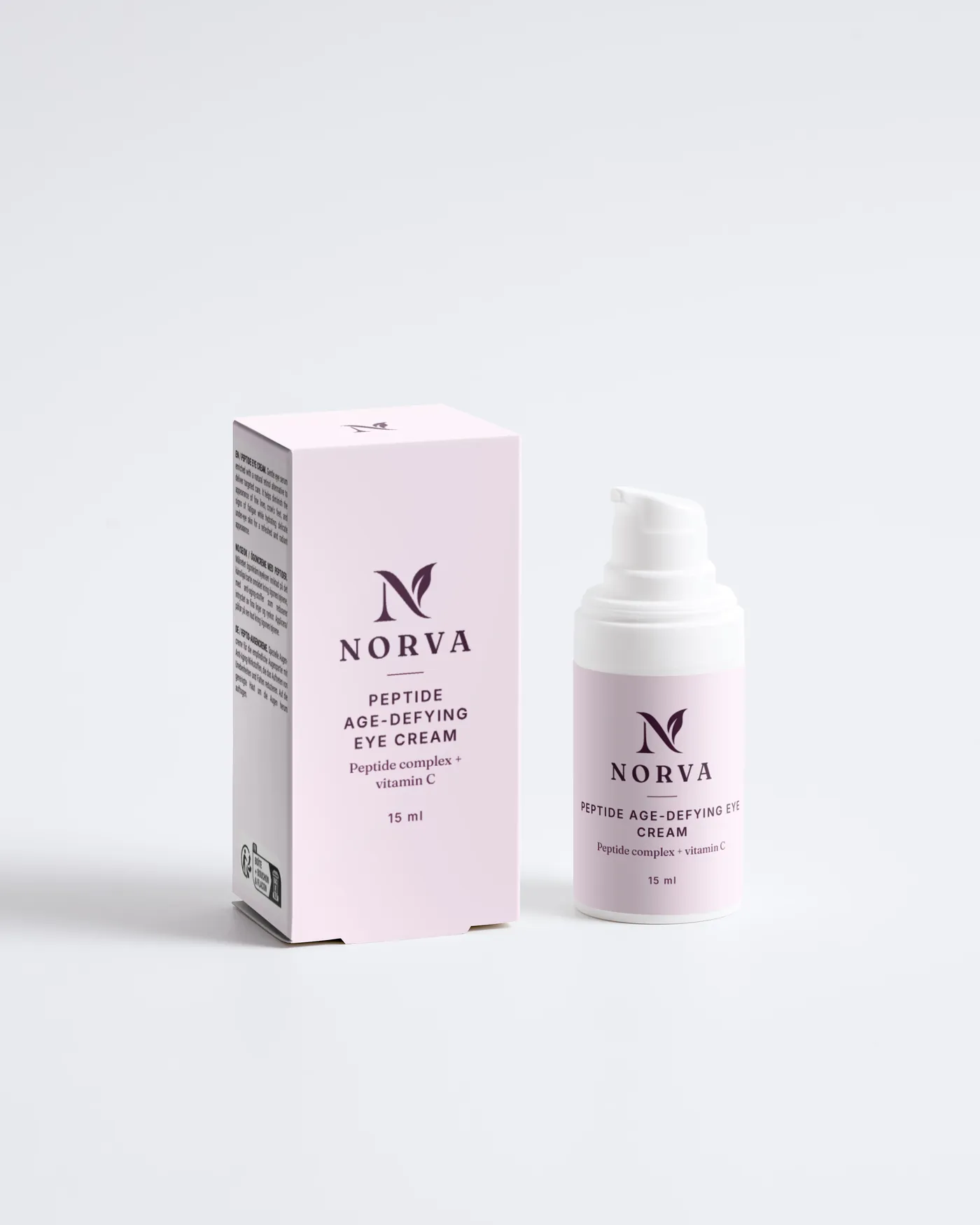
Ours is the Peptide Age-Defying Eye Cream, £24 for 15 ml. The reasoning for choosing cream over serum is below, along with the cases where we would send you to a serum.
Why the eye area is a special case
Two things are different about the skin around your eyes, and they both bear on the choice.
It is thin. An ultrasound study of 45 adults aged 22 to 73 mapped skin thickness at 38 points on the face. The upper eyelid was the thinnest site measured, with a median of about 0.57 mm, against roughly 1.9 mm at the tip of the nose (Korzekwa and colleagues, 2025).
Eyelid skin is also short of its own oil. A review of how the outer skin layer differs from place to place on the face describes eyelid skin as distinct from every other facial site: poor in skin surface lipids, with a thin outer layer, which leaves it well hydrated at the surface but with a poor barrier function (Tagami, 2008). In plain terms, the eye area does not hold on to water well and does not make much of the oil that would help it.
That second point is the whole argument for a cream. Moisturisers work through a mix of humectants, which draw water in, emollients, which smooth, and occlusives, which slow water leaving (Lynde, 2001). A serum is mainly the first of those. A cream has all three. On skin that is naturally low in surface oil, the emollient and occlusive parts are doing real work.
What a peptide eye serum is good at
A serum is a thin, usually water-based liquid. It spreads easily, sinks in fast and leaves almost nothing on the surface. That gives it three real advantages around the eyes.
Under make-up. Concealer slides and creases on top of a rich cream. A serum gives it a dry, smooth surface to sit on.
On oily or combination skin. Some people find eye creams look greasy or feel heavy by lunchtime. A serum leaves out the oils and butters that cause that.
For puffiness. Light eye serums often carry ingredients aimed at puffiness and dark circles alongside the peptides, and a thin liquid is a natural base for them. The Ordinary's Multi-Peptide Eye Serum is the obvious example. When we checked its UK page on 30 September 2026 it was £19.90 for 15 ml (on offer at £17.91 that day), a water-based serum with 5% caffeine, niacinamide and a long list of named peptide technologies, stated to target crow's feet, dark circles and puffiness, to be applied morning and evening. No percentages were given for the individual peptides. It is listed as alcohol-free, oil-free and silicone-free.
That last detail is the trade-off in one phrase. Oil-free is the point of an eye serum, and it is also its limit.
What an eye cream is good at
An eye cream is an emulsion: water and oil held together, with the humectants of a serum plus emollients on top. It takes a little longer to sink in and leaves a soft film.
On dry or crepey skin. If the skin under your eyes looks papery by mid-afternoon, it is losing water. A cream slows that. A serum on its own does not.
At night. Nobody is applying concealer at bedtime, so the one disadvantage of a cream disappears.
On older skin. Skin generally gets drier with age, and the eye area had the least oil to start with.
As the only eye product. A cream is a moisturiser and a treatment in one. With a serum you often end up needing a cream over it anyway.
There is a small piece of evidence on the base that we find persuasive. In a 60-day controlled study, 76 women aged 30 to 60 applied a cream with 0.1% hyaluronic acid around one eye and a plain vehicle cream around the other, twice a day. Hydration and elasticity improved significantly against the vehicle for every molecular weight tested, and the two smallest also reduced measured wrinkle depth (Pavicic and colleagues, 2011). That study was done with creams, around the eyes, which is exactly the use we are talking about. It is about hyaluronic acid and not peptides, and we do not publish molecular weights for our own products, so we are not claiming that result for ours.
Are the peptides different in a serum and a cream?
Mostly not. The same peptides turn up in both formats, and the published research on cosmetic peptides is organised by type of peptide, not by whether it was in a serum or a cream (Gorouhi and Maibach, 2009).
What can differ is how many. Eye serums, like face serums, are often "multi-peptide" blends with several named technologies and no stated amounts. Eye creams tend to list fewer. Neither tells you the dose unless the brand prints it. Our eye cream lists hexapeptide-11 in its ingredients, as part of what we describe as a peptide complex, and we do not state a percentage for it. If a stated peptide percentage is the thing you care about most, our eye cream does not give you one, and we would rather you knew that before buying.
Can you use a face peptide serum around your eyes?
This is the third thing people ask, and it is a fair question: if there is already a peptide serum on your face, why buy a second product for a few square centimetres.
You can take most face serums up to the orbital bone, the ridge you can feel around the eye socket. That covers crow's feet and the upper cheek. Where to be careful is the eyelid itself and the lash line. Products migrate as they warm up, and the skin there is the thinnest and least protected on the face. Unless a label says the product is suitable for the eye area, keep it on the bone and off the lid.
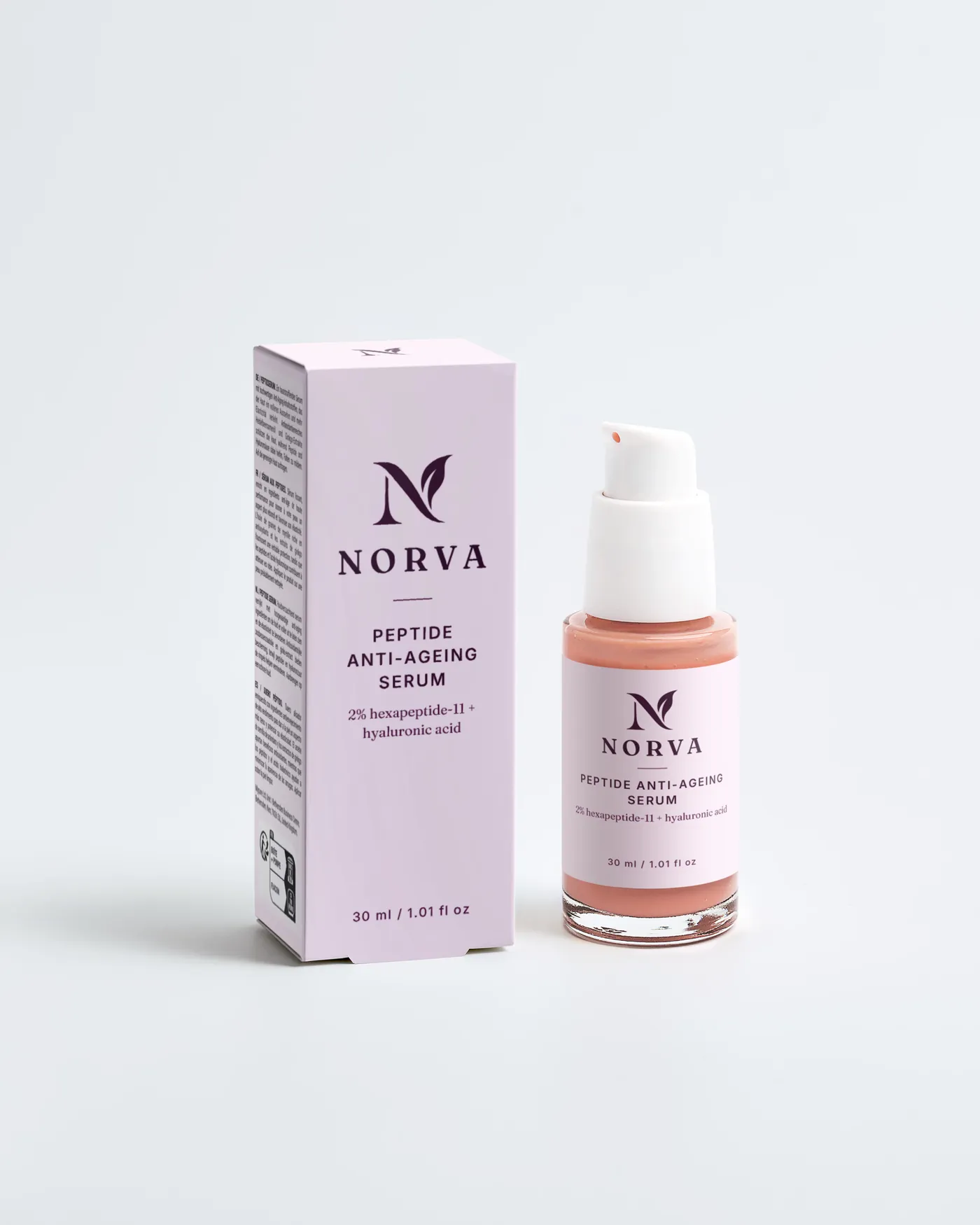
Fragrance is the other consideration. Our face serum, the Peptide Anti-Ageing Serum, is fragranced, and we would not put it on eyelids. Our eye cream is fragranced too, with a soft rose and geranium scent, but it is made for the eye area and the directions are to apply it gently to the skin around the eyes. If fragrance near your eyes worries you at all, choose a fragrance-free eye product from another brand, or look at our hydrogel patches, which are fragrance-free.
So: a face peptide serum can do crow's feet. It is not a substitute for an eye product on the under-eye and lid, mainly because a face serum has no cream base to make up for the eye area's lack of oil.
Serum and cream together
Some people use both: eye serum first, a little eye cream over the top. It works, in the same way that serum then moisturiser works on the rest of the face.
Whether it is worth the money is another matter. Two 15 ml tubes for an area the size of two postage stamps is a lot of product. We would only layer if you have tried the serum alone and the area still feels dry, or you particularly want caffeine in the morning and a cream at night. In that case use the serum in the morning under make-up and the cream in the evening. You get both textures without doubling up at the sink.
How to apply either one
The method matters more than the format.
- After cleansing and your face serum, take an amount the size of a grain of rice for both eyes.
- Dot it along the orbital bone, under the eye and out to the temple.
- Pat with your ring finger until it has gone. Do not drag.
- Keep it a few millimetres away from the lash line. It will travel the rest of the way by itself.
- Follow with face moisturiser, keeping that away from the eye area, then sunscreen in the morning.
Twice a day. Our peptide eye cream guide goes into application in more detail, and our peptide skincare routine shows where the eye step sits among the others.
Which one for which person
Oily skin, eye creams feel heavy, or you wear concealer daily. Eye serum.
Morning puffiness is the main complaint. Eye serum, ideally one with caffeine, kept in the fridge. Or patches.
Dry, crepey or lined under-eyes. Eye cream.
Over about 35 with normal to dry skin. Eye cream.
Contact lens wearer or watery eyes. Whichever you choose, use less and keep it further from the lashes. Fragrance-free is the cautious choice.
One product only, smallest budget. Eye cream, because it moisturises as well.
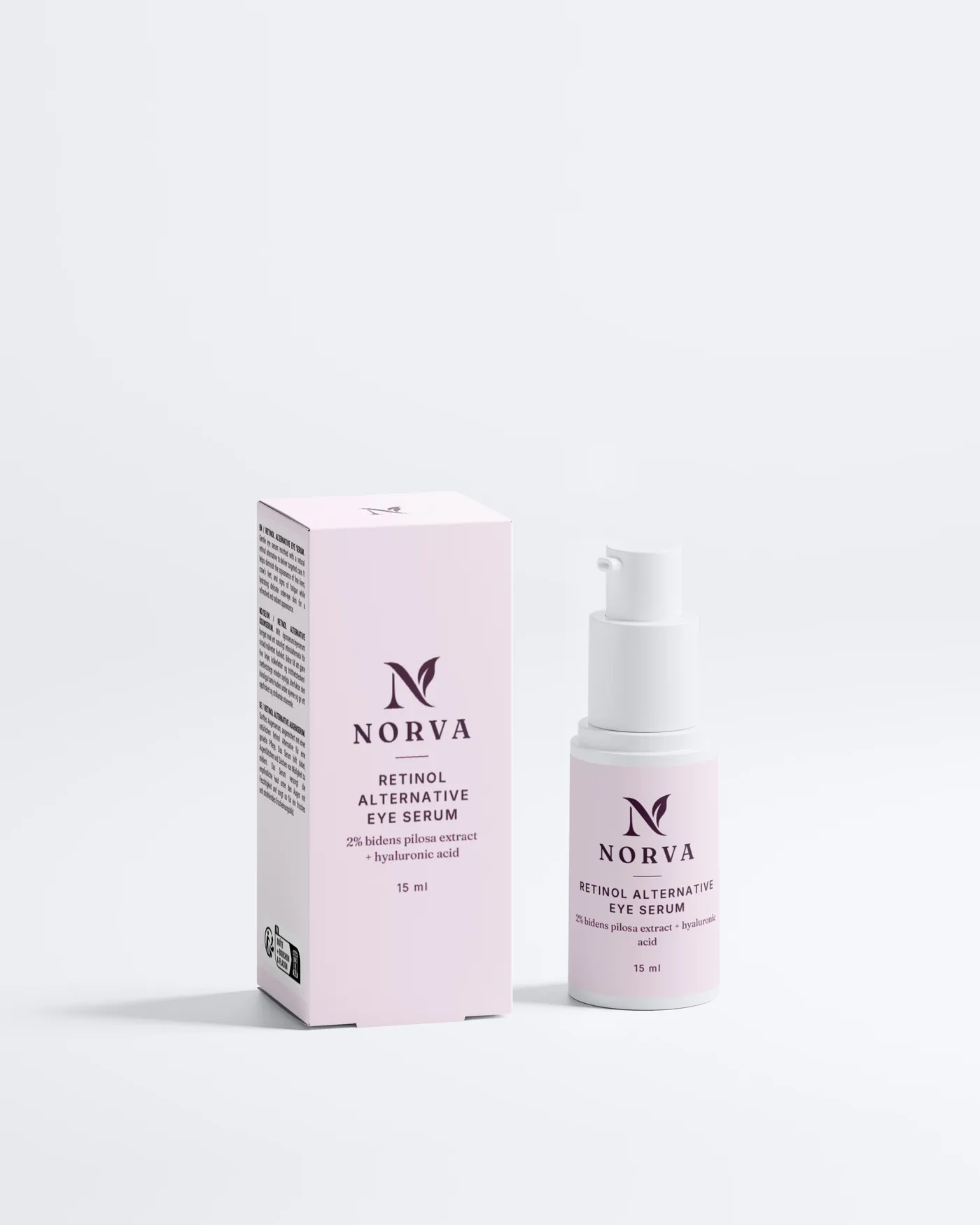
You want a gentle retinol alternative near the eyes, not a peptide. That is a different product. Our Retinol Alternative Eye Serum is £24 for 15 ml with 2% bidens pilosa extract, hyaluronic acid, aloe juice, jojoba and castor oil. It is a serum in name and it is richer than most, because of the oils. It is fragranced, soft rose with a touch of geranium.
What we make for the eye area
The Peptide Age-Defying Eye Cream is £24 for 15 ml. It is a lightweight cream with a peptide complex, vitamins C and E and sodium PCA, in a base that includes jojoba oil, borage seed oil and mango seed butter. It is for all skin types, made in the EU, and used morning and evening. It is fragranced: soft rose with a touch of geranium, and the ingredient list includes fragrance with linalool, geraniol and citronellol from natural essential oils.
On a subscription it is 10% off for one every 30 days, 15% off for two every 60 days or 20% off for three every 90 days. A 15 ml tube on its own is under the £55 free delivery line, so it makes most sense added to something else. With the serum and the face cream it comes as The Peptide Routine at £73, which is £13 less than the three bought separately and does qualify for free UK and EU delivery. Orders are made in the EU and typically arrive in 6 to 10 working days, with 30-day returns on unused items.
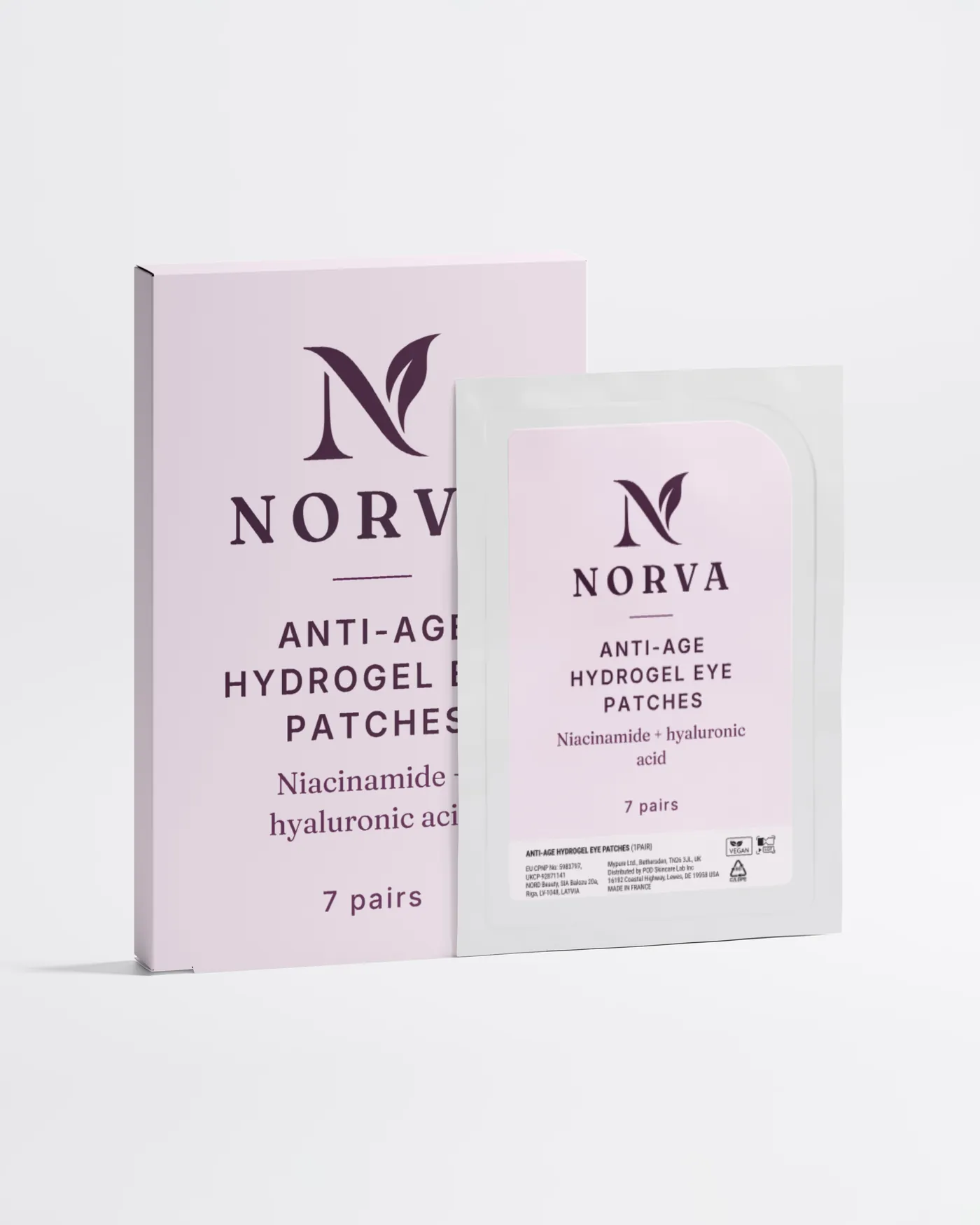
For the occasional boost, our Anti-Age Hydrogel Eye Patches are £26 for 7 pairs, fragrance-free, with niacinamide and hyaluronic acid, worn for 15 minutes.
What to expect from either
Hydration and a smoother look within days. That is the humectants, and it is the same whether they arrive in a serum or a cream.
Any change in how fine lines look takes longer. Give it eight weeks of twice-daily use and compare photos taken in the same light.
Some things no eye serum or eye cream will change much: hollows, deep-set dark circles that run in the family, and bags caused by the fat pad under the eye. Those are structural, and a cosmetic works on the surface.
Sunscreen and sunglasses will do more than either product. In a randomised trial of 903 adults over four and a half years, daily sunscreen users showed 24% less skin ageing than those who used it when they chose to (Hughes and colleagues, 2013). Crow's feet are in large part a sun and squinting story.
Who this is not for
If you react to fragrance, neither of our eye products is right for you; both are fragranced, and the eye area is the last place to test your luck. If you specifically want a multi-peptide eye serum with caffeine, we do not make one, and The Ordinary's is the obvious place to look. If you have sore, swollen, flaky or itchy eyelids, that is a job for a pharmacist or GP before it is a job for a cosmetic. And if you are in your early twenties with no dryness, your face moisturiser taken carefully up to the orbital bone is enough.
The short version
Serum or cream is a question about texture, not about peptides. Oily, puffy or under make-up: a peptide eye serum. Dry, lined or mature: an eye cream, because eyelid skin is thin, low in its own oil, and loses water easily. A face peptide serum can go as far as the orbital bone but is not a stand-in for an eye product. Ours is a cream, the Peptide Age-Defying Eye Cream at £24 for 15 ml, fragranced, used morning and evening. Patch test on the inner arm for 24 hours before first use.
References
- 1.Tagami (2008). Location-related differences in structure and function of the stratum corneum with special emphasis on those of the facial skin. International Journal of Cosmetic Science.
- 2.Korzekwa et al. (2025). Quantitative Analysis of the Human Face Skin Thickness: A High-Frequency Ultrasound Study. Journal of Clinical Medicine.
- 3.Pavicic et al. (2011). Efficacy of cream-based novel formulations of hyaluronic acid of different molecular weights in anti-wrinkle treatment. Journal of Drugs in Dermatology.
- 4.Lynde (2001). Moisturizers: what they are and how they work. Skin Therapy Letter.
- 5.Gorouhi and Maibach (2009). Role of topical peptides in preventing or treating aged skin. International Journal of Cosmetic Science.
- 6.The Ordinary Multi-Peptide Eye Serum UK product page, checked 30 September 2026.
- 7.Hughes et al. (2013). Sunscreen and prevention of skin aging: a randomized trial. Annals of Internal Medicine.
Related questions
Is a peptide eye serum better than an eye cream?
Neither is better across the board. A serum is lighter and suits oily skin, puffiness and wear under make-up. A cream carries oils and butters that the eye area is short of, so it suits dry, lined or mature skin. Choose by how your eye area feels, not by the word on the box.
Can I use my face peptide serum around my eyes?
You can take most face serums up to the bone around the eye socket. Keep them off the eyelids and lash line unless the label says the product is made for the eye area, and be cautious with fragranced formulas so close to the eyes.
Can I use an eye serum and an eye cream together?
Yes. Serum first, then a small amount of cream over it. It is only worth doing if the serum alone leaves the area feeling dry. For most people one product is enough.
What is a multi peptide eye serum?
An eye serum containing several peptides in a light, water-based formula. The Ordinary's, for example, names several peptide technologies with 5% caffeine and was £19.90 for 15 ml when we checked on 30 September 2026.
Do you sell a peptide eye serum?
No. Our peptide product for the eyes is a cream, the Peptide Age-Defying Eye Cream at £24 for 15 ml. We also make a Retinol Alternative Eye Serum with 2% bidens pilosa at £24, which is a serum but not a peptide one. Both are fragranced.
Gear for this
Related reading
Peptide Eye Cream: What to Expect and How to Apply It
A straight guide to peptide eye cream: why the eye area ages first, what peptides can do for fine lines, how to apply it, and how to pick one in the UK.
Peptide Skincare Routine: When to Use Peptide Serum, AM and PM
When to use peptide serum: morning and night, on clean skin, before cream. A simple peptide skincare routine with the order of serum, eye cream and cream.
How to Apply Your Skincare, and in What Order
Where each Norva product sits in a morning and evening routine, how to layer a serum under a cream without pilling, and the order for the Peptide Routine, the Barrier Reset Routine and Sensitive Skin Essentials.