Loading…
Science
Retinol and Peptide Serum: Can You Use Both, and in What Order?
11 min read
People asking about a retinol and peptide serum usually arrive holding two bottles. One says retinol, one says peptides, and the internet has told them both are for fine lines. They want to know whether both can go on the same face, and which goes first.
We should be clear about where we stand before answering. We sell a peptide serum and a plant-based retinol alternative. We do not sell retinol. So we have every commercial reason to tell you peptides are better, and we are not going to, because the evidence does not say that.
Can you use a retinol and peptide serum together?
Yes. A retinol and peptide serum can be used in the same routine, and many people do. They act in different ways, neither is known to cancel the other out, and peptides are gentle enough to sit alongside an ingredient that often is not. The easiest pattern is peptide serum in the morning and retinol at night. If you want both in the evening, put the thinner one on first and finish with a moisturiser. Introduce them one at a time, a few weeks apart, so that if your skin complains you know which bottle to blame.
That is the answer an AI summary would give you, and it is correct. The more useful question is what each one is actually for, because plenty of people do not need both.
What retinol has going for it
Retinol is a form of vitamin A. It belongs to a family called retinoids, which also includes prescription tretinoin. This family has been studied for skin ageing for decades, and the evidence is the strongest of any cosmetic ingredient class.
A review of retinoids in skin ageing describes tretinoin as possibly the most potent and certainly the most widely investigated, with histological and clinical improvement shown in many studies, most of them on sun-aged skin (Mukherjee and colleagues, 2006). Retinol itself, the over-the-counter form, has direct trials. In one, 36 elderly people with a mean age of 87 had a 0.4% retinol lotion applied to one arm and a plain vehicle to the other, up to three times a week for 24 weeks. Fine wrinkling scores improved significantly on the retinol side, and biopsies from a small subgroup showed more procollagen and more of the water-holding molecules called glycosaminoglycans (Kafi and colleagues, 2007). That is a small trial on arms, not faces, but it was randomised, double-blind and vehicle-controlled, which is more than most skincare can claim.
Retinol has also been compared directly with prescription retinoic acid. Four weeks of either increased epidermal thickness and switched on collagen genes, with retinol producing similar changes of a smaller size, and facial image analysis showed a significant reduction in wrinkles after 12 weeks of retinol (Kong and colleagues, 2016). Several of the authors worked for a company that sells skincare, so read it with that in mind. It agrees with the independent work all the same.
What retinol costs you
The price is irritation. The same review that praises retinoids says plainly that irritant reactions such as burning, scaling or dermatitis limit how well people accept them. It adds that this problem is worse with tretinoin and tazarotene, and that retinaldehyde and retinol are considerably less irritating (Mukherjee and colleagues, 2006).
There is a barrier angle too. When researchers patch-tested prescription-strength retinoic acid on healthy skin, it caused more scaling than a detergent irritant, and water loss through the skin rose a week later, which the authors read as a delayed weakening of the outer barrier (Effendy and colleagues, 1996). That was retinoic acid under a patch, a harsher test than dabbing on a shop-bought retinol. It does explain why people starting any retinoid so often report a fortnight of tight, flaky skin.
None of this makes retinol bad. It makes it an ingredient you introduce slowly, use at night, and pair with a decent moisturiser and daily sunscreen. If you are pregnant, trying to conceive or breastfeeding, ask your midwife, pharmacist or GP before using any retinoid.
What peptides have going for them
Peptides are short chains of amino acids. A review of controlled studies groups the cosmetic ones into signal peptides, carrier peptides, enzyme-inhibitor peptides and neurotransmitter-inhibitor peptides (Gorouhi and Maibach, 2009). Each has its own small stack of evidence. There is no single "peptide" result in the way there is a retinoid result.
The better individual studies are encouraging. In one, 93 women aged 35 to 55 used a moisturiser on one side of the face and the same moisturiser with a palmitoyl pentapeptide on the other for 12 weeks, double-blind. The peptide side showed a significant improvement in fine lines and wrinkles on both instrument and expert grading, and it was well tolerated (Robinson and colleagues, 2005). The study was run by the company that makes the product, which is common in this field and worth knowing.
Our own serum uses hexapeptide-11. In a study in Redox Biology it switched on genes linked to the cell's housekeeping and antioxidant systems in human skin fibroblasts, protected those cells against stress-induced premature ageing, and improved skin elasticity in deformation tests on human volunteers (Sklirou and colleagues, 2015). One study. The authors call the peptide promising, and that is the right word.
What peptides clearly have over retinol is tolerance. You can use them twice a day from the first day. There is no adjustment period and no peeling week, and they do not need keeping away from the morning.
If you want a way to weigh a 93-person company trial against a 36-person academic one, our guide to reading small skincare trials is written for exactly that.
Peptides vs retinol: the honest scorecard
| | Retinol | Peptides | |---|---|---| | Size of evidence base | Large, decades old | Smaller, peptide by peptide | | Best human evidence | Randomised, vehicle-controlled trials | A handful of controlled trials, often company-run | | Irritation | Common while skin adjusts | Uncommon | | When to use | Evening | Morning and evening | | Adjustment period | Yes, build up over weeks | No | | Suits reactive skin | Often not at first | Usually |
If the only thing you care about is the weight of published evidence for how fine lines look, retinol wins. If what you care about is something you will keep using without your face flaking, peptides win. Those are different questions, and most of the "peptides vs retinol" arguments online come from people answering one while the other person is asking the other.
The order, if you use both
There are three sensible ways to run a retinol and peptide serum in one routine.
Split by time of day. Peptide serum in the morning under moisturiser and sunscreen. Retinol at night under moisturiser. This is the pattern we would pick. Each product gets clean skin, and the retinol is kept away from daylight hours.
Both at night, thin to thick. Cleanse, peptide serum, then retinol, then moisturiser. Most peptide serums are lighter than most retinol creams, so the peptide goes first. If your retinol is a watery serum and your peptide product is a cream, swap them.
Both at night, buffered. If retinol stings, put your peptide serum and a thin layer of moisturiser on first, then the retinol over the top. You are putting something between the retinol and your skin to take the edge off. Some people find this is the difference between tolerating retinol and giving up on it.
Whichever you choose, keep the peptide serum twice a day and start retinol at one or two nights a week. Add a night every couple of weeks if your skin stays calm. On the mornings after, wear sunscreen. In a four-and-a-half-year randomised trial of 903 adults, daily sunscreen users showed 24% less skin ageing than those who used it at their own discretion (Hughes and colleagues, 2013), and that result is bigger than anything a serum of either kind has shown.
For the wider layering order with cleansers, eye cream and everything else, see how to apply your skincare, and in what order.
Who should pick which
Your skin is sensitive, dry or easily red. Peptides first. Get a routine settled for two or three months. Then decide whether you want to try a low-strength retinol.
You have used retinol happily for years. Keep it. Add a peptide serum in the morning if you want a second ingredient that asks nothing of your skin.
You tried retinol and your skin hated it. You have two options. Use peptides alone, or look at a retinol alternative, which we cover below.
You are in your twenties and mostly want to look after what you have. Sunscreen and moisturiser. Honestly. Either serum can wait.
You want the most evidence per pound and your skin is tough. Retinol at night, from a brand that states the percentage, and a plain moisturiser. We do not sell it, and you should still buy it.
Where a retinol alternative fits
Some people want what retinol is aimed at without the flaking. That is the idea behind plant-based "retinol alternatives", and ours uses bidens pilosa extract.
The research is early. In a lab study, a bidens pilosa extract increased collagen, elastin and glycosaminoglycan levels in human fibroblasts and skin fragments and acted on the same retinoid receptors that retinol uses, with effects the authors describe as similar to or better than retinol and retinoic acid in those tests (Dieamant and colleagues, 2015). Most of the authors worked for a cosmetic ingredient company, and the work was done on cells and skin samples, not on people's faces over months. It is a reason to be interested. It is not proof of equivalence, and bidens pilosa is not a retinoid. We go through exactly what it can and cannot do in our guide to bidens pilosa.
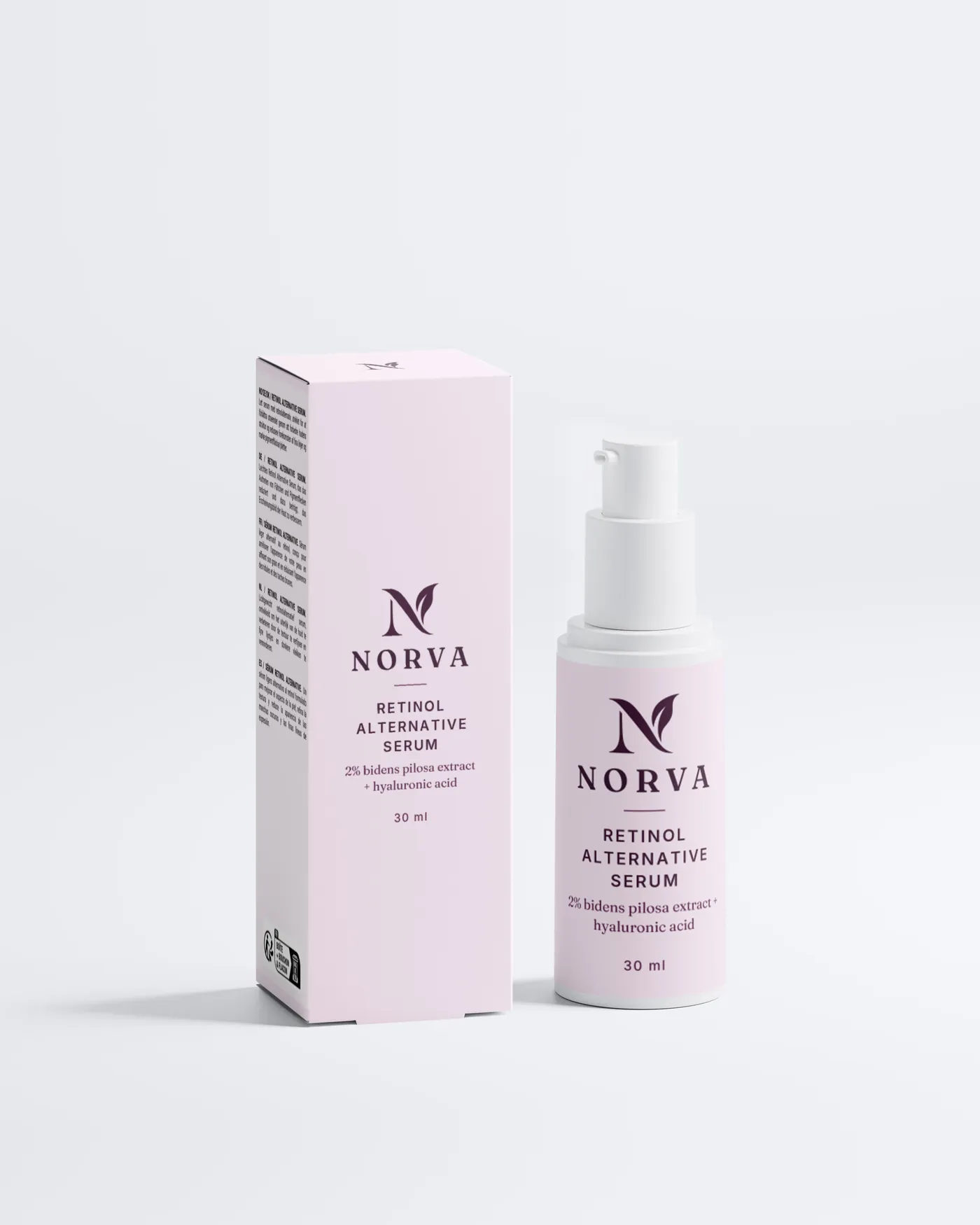
Our Retinol Alternative Serum is £30 for 30 ml, with 2% bidens pilosa extract, hyaluronic acid, vitamins C and E and jojoba oil. It can be used morning, evening or both. It is fragranced, a soft rose with a touch of geranium, and it suits all skin types.
What we sell, and how the two fit together
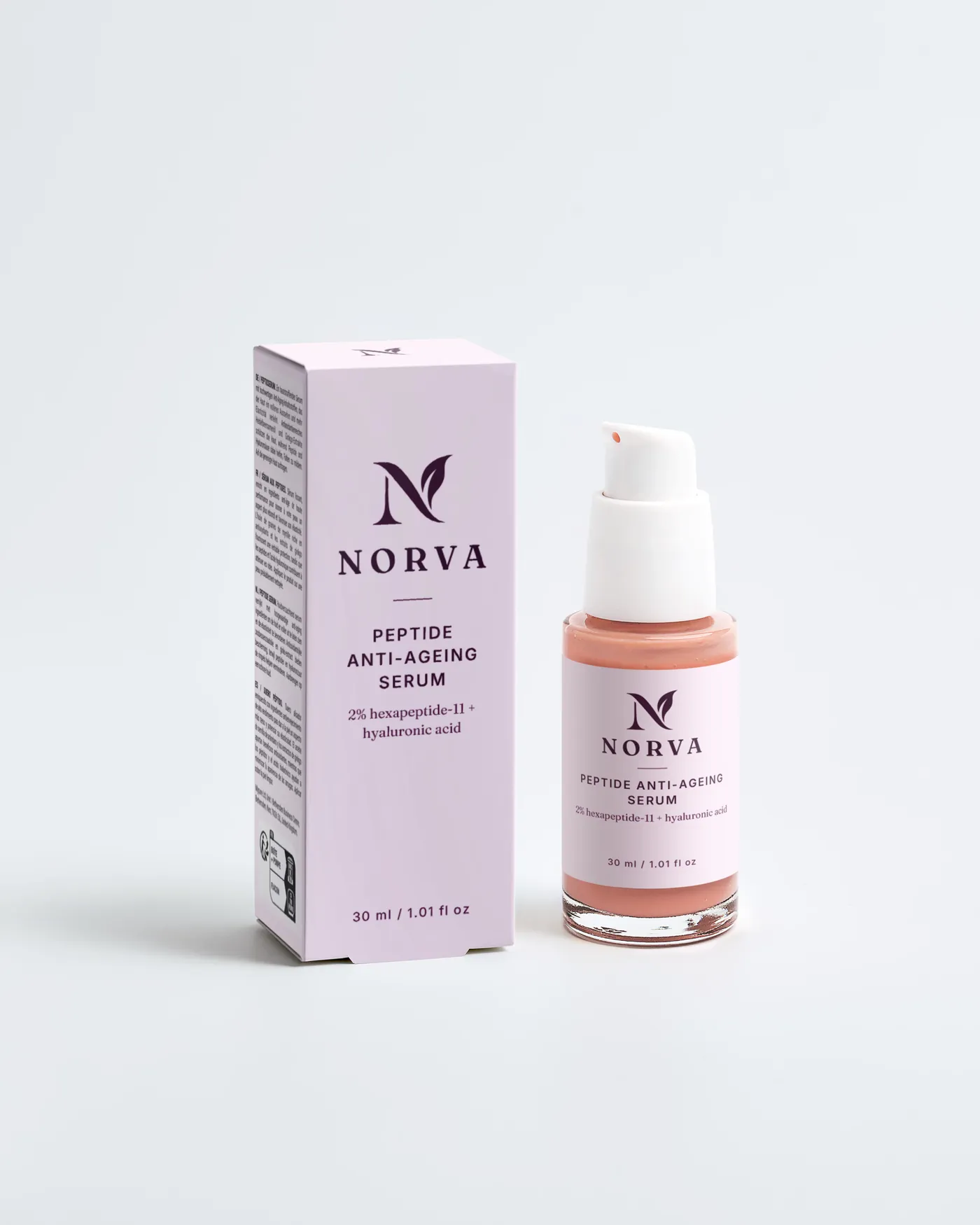
The Peptide Anti-Ageing Serum is £30 for 30 ml: 2% hexapeptide-11, hyaluronic acid, 1% ginkgo biloba extract, and blueberry and strawberry seed oils, for normal, dry and dehydrated skin. It is fragranced, a delicate floral with soft amber notes.
If you want to use both of ours, the pattern mirrors the retinol one. Peptide serum in the morning, Retinol Alternative Serum in the evening, moisturiser over each, sunscreen by day. Because neither needs building up, you can start both at full frequency, though we would still begin them a fortnight apart so you can tell what is doing what.
Anyone who already owns a retinol they like from another brand should keep it for the evening and use our peptide serum in the morning. We would rather you did that than throw away a product that works for you.
Each serum is also available on a subscription at £27 every 30 days for one bottle, £51 every 60 days for two, or £72 every 90 days for three. Everything is made to order in the EU and typically arrives in 6 to 10 working days, with free UK and EU delivery over £55 and 30-day returns on unused items. Two serums at £30 each takes you over the free delivery line.
Common mistakes
Starting retinol and a new peptide serum in the same week. When your cheeks go red on day five you will not know which one did it.
Using retinol every night from the start because the bottle is small and you want it to work faster. It will work slower, because you will stop.
Dropping the moisturiser because you are now using two serums. Serums are not moisturisers, and retinol in particular needs one over it.
Expecting either to show anything in a fortnight. The retinol trials above measured results at 12 and 24 weeks. The peptide trial ran for 12. Take a photo on day one and another at week twelve, in the same light.
Treating "retinol alternative" as meaning "retinol, but nicer". It means a different ingredient with a shorter research history.
Who this is not for
If you have acne, rosacea, eczema or melasma, the choice between retinoids and anything else is a conversation for a GP or dermatologist, and prescription retinoids are medicines with their own rules. If you react to fragrance, neither of our two serums is right for you, because both are fragranced. And if you are looking for a page that declares a winner, we cannot give you one. The two ingredients have not been tested head to head in a proper trial, so anyone who tells you peptides "beat" retinol, or the reverse, is guessing.
The short version
You can use a retinol and peptide serum together: peptides in the morning, retinol at night, or both in the evening with the thinner one first. Retinol has the deeper evidence and the higher chance of irritation. Peptides have lighter evidence and almost no downside. If your skin tolerates retinol, there is no reason to choose. If it does not, a peptide serum is the place to start, and our Peptide Anti-Ageing Serum is £30 with its peptide and percentage printed on the label. Patch test on the inner arm for 24 hours before first use.
References
- 1.Mukherjee et al. (2006). Retinoids in the treatment of skin aging: an overview of clinical efficacy and safety. Clinical Interventions in Aging.
- 2.Kafi et al. (2007). Improvement of naturally aged skin with vitamin A (retinol). Archives of Dermatology.
- 3.Kong et al. (2016). A comparative study of the effects of retinol and retinoic acid on histological, molecular, and clinical properties of human skin. Journal of Cosmetic Dermatology.
- 4.Effendy et al. (1996). Differential irritant skin responses to topical retinoic acid and sodium lauryl sulphate: alone and in crossover design. British Journal of Dermatology.
- 5.Robinson et al. (2005). Topical palmitoyl pentapeptide provides improvement in photoaged human facial skin. International Journal of Cosmetic Science.
- 6.Sklirou et al. (2015). Hexapeptide-11 is a novel modulator of the proteostasis network in human diploid fibroblasts. Redox Biology.
- 7.Gorouhi and Maibach (2009). Role of topical peptides in preventing or treating aged skin. International Journal of Cosmetic Science.
- 8.Dieamant et al. (2015). Antiageing Mechanisms of a Standardized Supercritical CO2 Preparation of Black Jack (Bidens pilosa L.) in Human Fibroblasts and Skin Fragments. Evidence-Based Complementary and Alternative Medicine.
- 9.Hughes et al. (2013). Sunscreen and prevention of skin aging: a randomized trial. Annals of Internal Medicine.
Frequently asked questions
Can I use retinol and a peptide serum together?
Yes. They work in different ways and are commonly used in the same routine. The simplest split is peptide serum in the morning and retinol at night. If you use both in the evening, apply the thinner product first and finish with moisturiser.
Which goes first, retinol or peptide serum?
Thinnest texture first. A water-based peptide serum usually goes on before a retinol cream or oil. If your retinol is a thin serum and your peptide product is a cream, reverse it. If retinol stings, putting the peptide serum or a moisturiser on first can make it more comfortable.
Are peptides as effective as retinol?
Retinoids have the larger and older body of evidence for how fine lines look. Peptides have smaller studies, some of them encouraging, and are much easier to tolerate. They are not interchangeable, and one is not a weaker version of the other.
Should I choose peptides or retinol if I have sensitive skin?
Start with peptides. Retinoids commonly cause burning, scaling or redness while skin adjusts, and peptides generally do not. You can add a low-strength retinol later, one or two nights a week, once your skin is settled.
Do you sell a retinol serum?
No. We sell a Peptide Anti-Ageing Serum with 2% hexapeptide-11 and a Retinol Alternative Serum with 2% bidens pilosa extract, each £30 for 30 ml. Both are fragranced. Bidens pilosa is a plant extract, not a retinoid.
Gear for this
Related reading
Retinol Alternatives: What Bidens Pilosa Can and Can't Do
Bidens pilosa is sold as a gentle, plant-based retinol alternative. Here is what the research shows, where it falls short of retinol, and who it suits.
Peptide Serum UK Guide: What It Is, Who It Suits, How to Use
A plain UK buyer's guide to peptide serum: what peptides do for how skin looks, what to check on the label, what a fair price is, and how to use one properly.
Why a Small 28-Day Skincare Trial Is Weak Evidence: A Worked Example
A 49-person, 28-day study of a peptide cream reported dermatologist-assessed improvements. Using it as a case study in how to read the clinical claims on any product page.
How to Apply Your Skincare, and in What Order
Where each Norva product sits in a morning and evening routine, how to layer a serum under a cream without pilling, and the order for the Peptide Routine, the Barrier Reset Routine and Sensitive Skin Essentials.