Loading…
Guide
Peptide Serum With Hyaluronic Acid: One Bottle or Two?
12 min read
Most people who search for a peptide serum with hyaluronic acid are trying to work out one thing: do I need two serums, or will one bottle do both. We sell a serum that combines them, so we have a side in this, but the short answer holds whoever you buy from.
Do you need a peptide serum with hyaluronic acid, or two separate serums?
One bottle is enough for most people. Peptides and hyaluronic acid do different jobs, they sit happily in the same formula, and a peptide serum with hyaluronic acid already in it saves you a step and a second purchase. Hyaluronic acid is the quick ingredient: it holds water at the skin surface, so skin looks plumper and feels smoother from the first use. The peptide is the slow one, judged over six to eight weeks. You only need a separate hyaluronic serum on top if your skin still feels tight after the combined one.
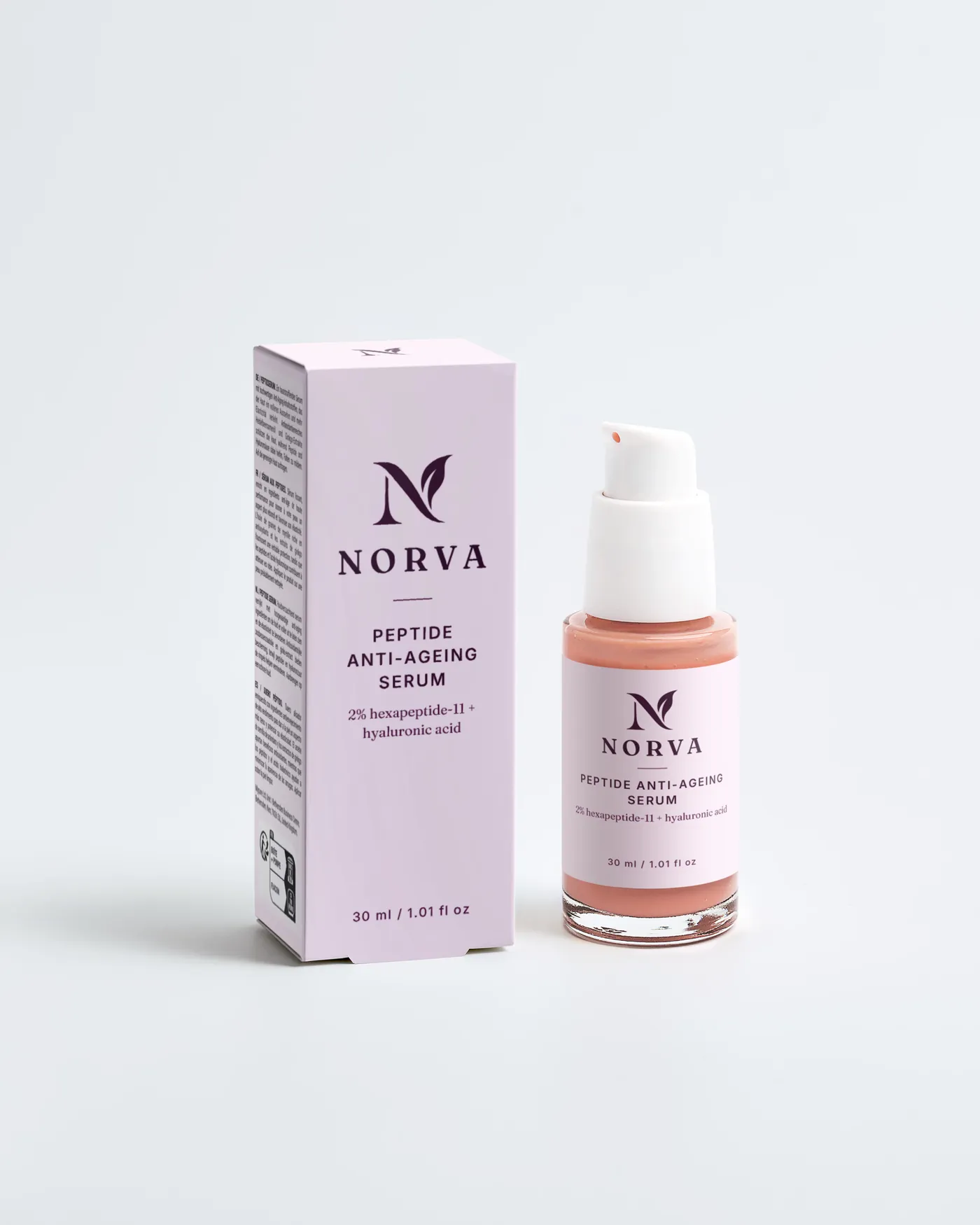
Our own version is the Peptide Anti-Ageing Serum, £30 for 30 ml, with 2% hexapeptide-11 and two forms of hyaluronic acid. The rest of this page explains what each half is doing, so you can judge any bottle, ours or somebody else's.
What hyaluronic acid does in a serum
Hyaluronic acid is a humectant, which is the word for an ingredient that binds water. Your skin makes its own. A review in Dermato-Endocrinology calls it the key molecule involved in skin moisture because of its capacity for retaining water, and notes that both normal ageing and daily external wear cause skin to lose moisture over time (Papakonstantinou and colleagues, 2012).
Put on the surface in a serum, it does a simple and quite reliable thing: it holds water in the outer layer, so skin looks fuller and fine dryness lines look softer. The effect is quick. In a six-week study of 40 women aged 30 to 65, a hyaluronic acid serum used twice a day raised measured skin hydration by 134% immediately after application and by 55% at week six, with the investigator also grading improvements in smoothness and plumpness (Draelos and colleagues, 2021). That is one product in one open study with no placebo group, so treat the exact percentages as that serum's result and not a promise for every formula. The direction is consistent across the literature though: hyaluronic acid hydrates, and you can see it.
There is one study we find more interesting, because it had a control. Seventy-six women aged 30 to 60 applied a cream with 0.1% hyaluronic acid around one eye and a plain vehicle cream around the other, twice a day for 60 days. Five different molecular weights were tested. All five significantly improved hydration and elasticity against the vehicle. Only the two smallest, 50 and 130 kDa, significantly reduced measured wrinkle depth (Pavicic and colleagues, 2011). The authors suggest the smaller molecules get a little further into the skin.
That is why you often see two hyaluronic names on one label. "Sodium hyaluronate" is the standard salt form. "Hydrolysed hyaluronic acid" has been broken into smaller pieces. Our serum contains both. We do not publish the molecular weights, so we are not going to claim the wrinkle-depth result for our bottle. What we can say is that the ingredient class has decent evidence for hydration, and that using a larger and a smaller form together is a sensible way to build a formula.
What the peptide does, and why it is slower
Peptides are short chains of amino acids. In skincare they are used to help skin look firmer and smoother over time. A review of controlled studies sorted cosmetic peptides into four groups: signal peptides, carrier peptides, enzyme-inhibitor peptides and neurotransmitter-inhibitor peptides (Gorouhi and Maibach, 2009). Different peptides, different proposed jobs, and a fairly thin evidence base for each.
Ours is hexapeptide-11, a six-amino-acid peptide with the sequence Phe-Val-Ala-Pro-Phe-Pro, first isolated from yeast extracts and now made synthetically. In a study published in Redox Biology, it switched on genes linked to the cell's own maintenance systems in human skin fibroblasts and protected those cells against premature ageing caused by oxidative stress. The same paper reports that in skin deformation tests on human volunteers, it improved skin elasticity (Sklirou and colleagues, 2015). The authors call it "promising". So do we. It is one study, and the cell work was done in a dish.
We are not going to repeat the whole peptide story here. If you want the basics of what a peptide serum is and who it suits, our peptide serum guide covers that. The point for this page is timing. Hyaluronic acid works on water, and water moves fast. Peptides are aimed at how skin behaves over weeks. A combined serum gives you something to notice on day one while the slower ingredient gets its eight weeks.
Why the two are paired so often
Walk down any skincare aisle and half the peptide serums say "+ HA" on the front. There are three plain reasons for that.
They do not get in each other's way, for a start. Hyaluronic acid is stable across the mild pH range that peptides like, and neither one deactivates the other. Compare that with direct vitamin C or exfoliating acids, which need a low pH and which some brands tell you to keep apart from their peptide serums.
Then there is feel. A peptide dissolved in water feels like water. Hyaluronic acid gives a serum some slip and cushion, which makes it nicer to use, which means you use it. We say this a lot because it is true: the serum you put on twice a day beats the better serum you forget.
Last, and we think it is worth being honest about, is the first week. If a peptide serum had no humectant in it, most people would give up before the peptide had a chance, because nothing would look different. The hyaluronic acid keeps you going until week eight. That is fine, as long as nobody pretends the day-one plumpness is the peptide working.
One combined serum or two separate ones?
Here is how we would decide.
Buy one combined serum if you want a short routine, your skin is normal to dry, and you would rather spend on one good bottle than two. This is most people.
Buy two separate serums if your skin is very dehydrated and drinks up everything you put on it, or if you already own a hyaluronic serum you love and only need to add the peptide. In that case it makes sense to layer.
Skip the peptide and buy only hyaluronic acid if hydration is your single complaint and you are not bothered about firmness or fine lines yet. A plain hydrating serum is cheaper thinking, and there is no shame in it. If you want to understand how hyaluronic acid compares with other humectants, our piece on beta-glucan versus hyaluronic acid goes into that.
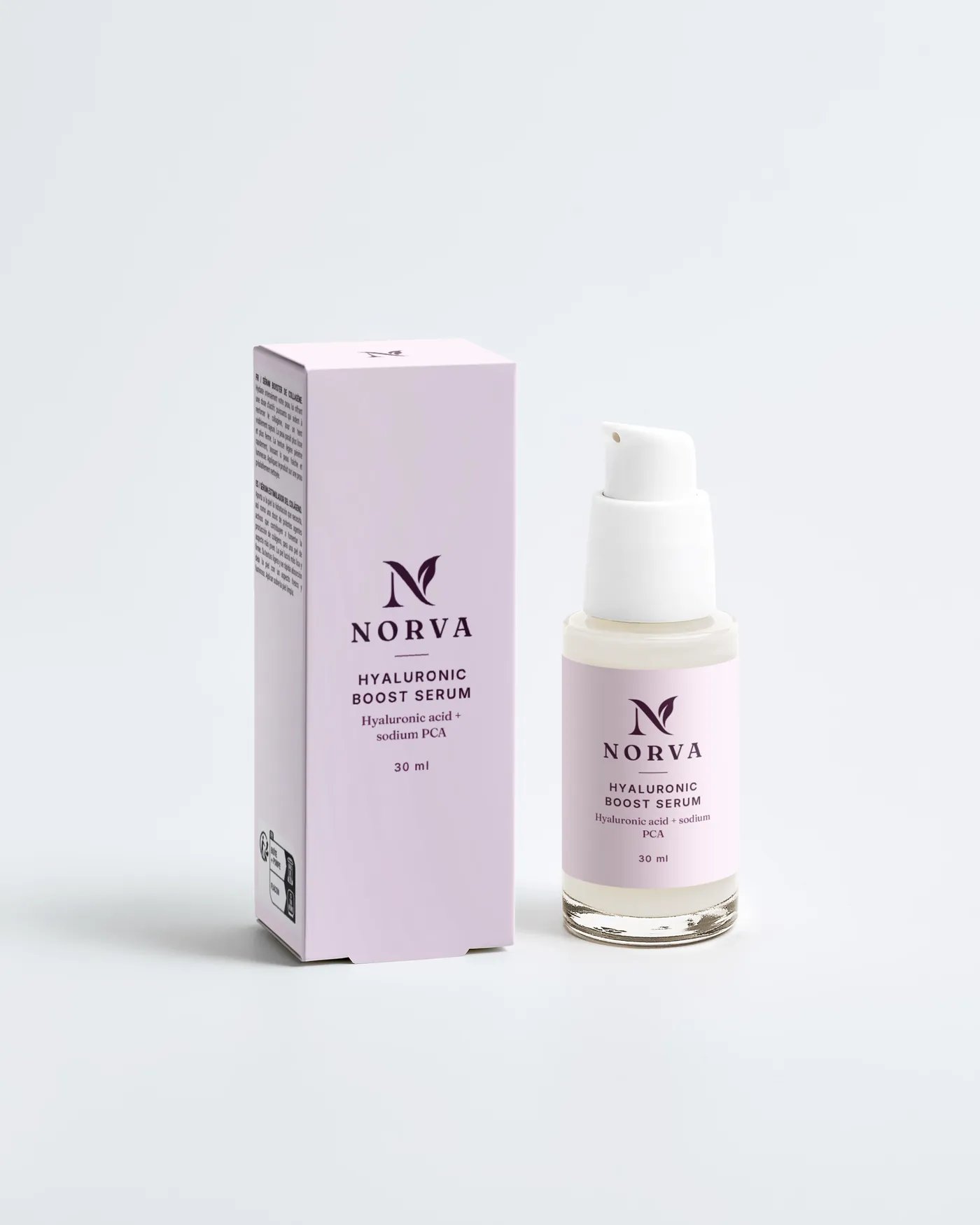
For the layering case, we make a Hyaluronic Boost Serum (£30, 30 ml) with hyaluronic acid, sodium PCA and sunflower oil for dry, dehydrated and mature skin. It layers well with the peptide serum. It is fragranced, with a powdery iris and violet scent, so the same fragrance caution applies to both.
How to layer peptides and hyaluronic acid if you buy them separately
The rule is thinnest texture first.
- Cleanse, and leave your face slightly damp. Humectants work by holding water, so give them some to hold.
- The lighter serum. This is usually the hyaluronic one. Two pumps, pressed in.
- The richer serum. Usually the peptide. Give the first layer half a minute, no longer. You are not waiting for it to dry, only to stop sliding.
- Moisturiser. This matters more than people think. A humectant with nothing over it can leave skin feeling tighter in dry indoor air, because the water it has gathered simply evaporates. A cream on top keeps it there.
- Sunscreen in the morning.
If you are using one combined serum, steps two and three collapse into one, and that is the whole attraction. For the full order with every other active slotted in, see how to apply your skincare, and in what order.
Morning and evening are both fine. Neither ingredient is one you have to keep for the evening, and neither needs building up slowly.
What to check on the label
Four things, whichever brand you are holding.
Which hyaluronic forms are listed. Look for sodium hyaluronate, hydrolysed hyaluronic acid or sodium hyaluronate crosspolymer in the INCI list. More than one form is a good sign. A "hyaluronic complex" with no INCI names is not.
Which peptide, and whether a percentage is given. Most brands name the peptides but not the amount. When we checked The Ordinary's UK page on 30 September 2026, its Multi-Peptide + HA Serum listed five peptide technologies and two hyaluronic ingredients with no percentages for any of them, at £15.90 for 30 ml (on offer at £14.31 that day). That is normal for the category, and it is very good value. We print 2% hexapeptide-11 on ours because we think a number helps you compare.
The base. A water-gel serum with peptides and hyaluronic acid suits oily and combination skin. Ours is richer: aloe leaf juice, jojoba oil, and blueberry and strawberry seed oils, with 1% ginkgo biloba extract. It is made for normal, dry and dehydrated skin. Very oily skin may find it too much in the daytime.
Fragrance. Ours is fragranced, a delicate floral with soft amber notes, and the ingredient list includes parfum along with linalool, geraniol and citronellol from natural essential oils. Most people are fine with that. A patch-test study of 3,119 adults in five European countries estimated fragrance contact allergy at about 1.9% of the general population (Diepgen and colleagues, 2015). If you are in that group, choose a fragrance-free serum. The Ordinary's does not list fragrance among its ingredients, and we would send you there before we would sell you something that makes you itch.
What it costs, ours and in general
Prices for a peptide serum with hyaluronic acid vary a lot from brand to brand, and the hyaluronic acid is never the expensive part. You are paying for the peptide, the base and the brand. We compare three of them side by side, including where ours loses, in our look at the best peptide serums in the UK.
Ours is £30 for 30 ml. On a subscription it is £27 every 30 days for one bottle, £51 every 60 days for two, or £72 every 90 days for three, and you can cancel when you like. It is made to order in the EU and typically arrives in 6 to 10 working days. Delivery is free in the UK and EU on orders over £55, and unused items can be returned within 30 days.
If you want the serum with the matching cream and eye cream, The Peptide Routine is £73 for all three, which is £13 less than buying them one at a time and clears the free delivery line.
What to expect, and when
Day one to week one. Skin looks a little plumper and feels smoother after each application. That is the hyaluronic acid. It fades if you stop.
Weeks two to four. Make-up sits better. Dry patches bother you less. Still mostly hydration.
By week six to eight. The first fair point to ask whether fine lines look any softer or skin looks any firmer. Take a photo in the same window light on the first morning and again at week eight. The mirror lies by small daily amounts.
At week twelve. If the photo shows nothing, this combination is not doing much for you, and you should stop paying for it. A plain hyaluronic serum and a good moisturiser will keep the hydration part going for less.
Mistakes we see
Putting hyaluronic acid on bone-dry skin in a centrally heated room and then nothing over it. It needs water underneath and a cream on top.
Buying a separate hyaluronic serum to go under a peptide serum that already has two forms of it. It will not hurt. It is simply money spent twice.
Judging the peptide on how skin looks at the end of week one. That is the humectant talking.
Adding a peptide and hyaluronic serum and skipping sunscreen. In a four-and-a-half-year randomised trial of 903 adults, the daily sunscreen group showed 24% less skin ageing than the group who used it when they felt like it (Hughes and colleagues, 2013). No serum has a result like that. If the budget only stretches to one thing, make it the SPF.
Who this is not for
If you react to fragrance, our serum is not for you; buy a fragrance-free one. If your skin is very oily, a rich peptide serum with seed oils in the base will probably feel heavy, and a water-gel formula is a better fit. If you are in your early twenties with no particular concern, a moisturiser and sunscreen will do more for you than any serum. And if you have eczema, rosacea or another condition a GP has named, ask them before adding new products. Everything on this page is about cosmetics, which help skin look and feel a certain way. None of it treats anything.
The short version
Peptides and hyaluronic acid are a sensible pair, and one bottle containing both is enough for most faces. The hyaluronic acid gives you hydration you can see this week. The peptide needs eight weeks and a before-and-after photo. Put a moisturiser over it, wear sunscreen in the morning, and do not buy a second hyaluronic serum unless your skin is still asking for one.
Our Peptide Anti-Ageing Serum is £30 for 30 ml, or £27 a month on a plan: 2% hexapeptide-11, two forms of hyaluronic acid, 1% ginkgo extract and berry seed oils, fragranced, made in the EU for normal, dry and dehydrated skin. Patch test on the inner arm for 24 hours before the first use.
References
- 1.Pavicic et al. (2011). Efficacy of cream-based novel formulations of hyaluronic acid of different molecular weights in anti-wrinkle treatment. Journal of Drugs in Dermatology.
- 2.Draelos et al. (2021). Efficacy Evaluation of a Topical Hyaluronic Acid Serum in Facial Photoaging. Dermatology and Therapy.
- 3.Papakonstantinou, Roth and Karakiulakis (2012). Hyaluronic acid: A key molecule in skin aging. Dermato-Endocrinology.
- 4.Sklirou et al. (2015). Hexapeptide-11 is a novel modulator of the proteostasis network in human diploid fibroblasts. Redox Biology.
- 5.Gorouhi and Maibach (2009). Role of topical peptides in preventing or treating aged skin. International Journal of Cosmetic Science.
- 6.Hughes et al. (2013). Sunscreen and prevention of skin aging: a randomized trial. Annals of Internal Medicine.
- 7.The Ordinary Multi-Peptide + HA Serum UK product page, checked 30 September 2026.
- 8.Diepgen et al. (2015). Prevalence of fragrance contact allergy in the general population of five European countries. British Journal of Dermatology.
Frequently asked questions
Can you use peptides and hyaluronic acid together?
Yes. They do different jobs and do not interfere with each other. Hyaluronic acid holds water at the skin surface so skin looks plumper straight away; peptides are the slower ingredient, judged over six to eight weeks. Many serums, including ours, put both in one bottle.
Which goes first, peptide serum or hyaluronic acid serum?
Thinnest first. A watery hyaluronic acid serum goes on before a richer peptide serum. If the peptide serum already contains hyaluronic acid, you do not need a separate one unless your skin still feels tight.
Is a peptide serum with hyaluronic acid better than hyaluronic acid on its own?
It does more, which is not the same as better. Hyaluronic acid alone is a hydration step. Adding a peptide gives you a second, slower ingredient aimed at how firm and smooth skin looks. If hydration is all you want, a plain hyaluronic serum is enough.
Does your peptide serum contain hyaluronic acid?
Yes. The Peptide Anti-Ageing Serum has 2% hexapeptide-11 with two forms of hyaluronic acid, hydrolysed hyaluronic acid and sodium hyaluronate. It is £30 for 30 ml and it is fragranced, with floral and amber notes.
How long does a peptide and hyaluronic acid serum take to work?
The hyaluronic acid part shows within minutes to days as a plumper, more hydrated look. The peptide part needs six to eight weeks of twice-daily use before you judge it, and results vary from person to person.
Gear for this
Related reading
Peptide Serum UK Guide: What It Is, Who It Suits, How to Use
A plain UK buyer's guide to peptide serum: what peptides do for how skin looks, what to check on the label, what a fair price is, and how to use one properly.
Beta-Glucan or Hyaluronic Acid: Choosing a Hydrator for Sensitive Skin
How beta-glucan and hyaluronic acid differ as humectants, which situations tend to suit each, and why the answer often depends on your climate and your moisturiser.
How to Apply Your Skincare, and in What Order
Where each Norva product sits in a morning and evening routine, how to layer a serum under a cream without pilling, and the order for the Peptide Routine, the Barrier Reset Routine and Sensitive Skin Essentials.